Term
Lead qualification
Lead qualification checks whether an enquiry fits a business and gives the team a reason to discuss a purchase. It helps identify leads to contact now, requests to revisit later and details that still need checking.
 Daria Lisovenko5 October 2026≈ 10 min.
What is lead qualification?
Lead qualification checks whether an enquiry fits a business and gives the team a reason to discuss a purchase. The team compares the person's answers with its criteria and follows up on missing information. It can then decide whether sales should follow up now, the request needs revisiting later or the company cannot provide the service.
In short: contact details tell you who you can reach. Qualification tells you what is worth discussing.
Two people submit a cleaning enquiry. One wants regular office cleaning; the other needs a one-off clean for a flat. For a company that only serves offices, those requests have different value. The second is not spam. It is a genuine request for a service this particular business does not offer.
Salesforce describes qualification as assessing a potential customer's fit with a company's offering. The criteria depend on the service. There is no single definition of a good lead that works for every business.
Qualification is not lead generation or a sale
Lead generation brings in enquiries. Qualification helps the company decide which ones it can serve. There is still a proposal to discuss and an agreement to reach. Even a suitable customer can decline or postpone a decision.
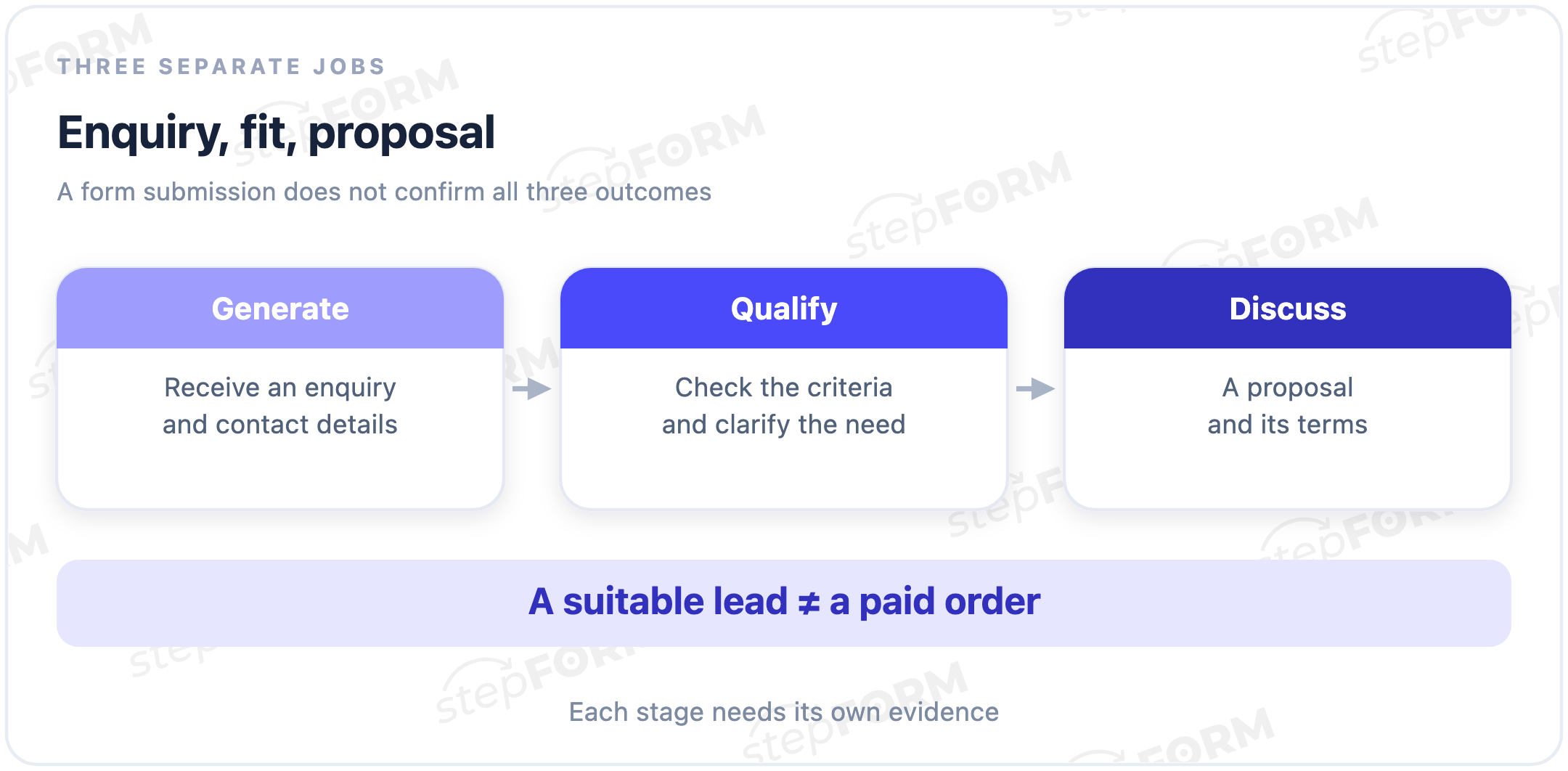
A lead form can collect contact details and information about a request. Having that data does not automatically qualify the person. Someone must check the responses against the criteria, record a conclusion and choose the next action. The separate task of attracting enquiries is covered in our article on lead generation.
Which criteria matter?
Start with what the company can actually provide: its services, the area it covers and the premises it handles. A rejection can then have a specific reason. A sales representative's impression that someone is not serious does not explain which condition failed.
| Criterion | What to find out | Why it is not enough on its own |
|---|---|---|
| Need | The outcome the person wants | General interest does not explain the scope of the work |
| Service fit | Premises, location and essential conditions | Suitable premises may still need a service the company cannot provide |
| Timing | When work should start and how flexible the date is | Urgency does not confirm that the company can take the job |
| Budget | Any estimate available and how spending is approved | “I don't know” does not mean “there is no money” |
| Decision process | Who selects the supplier and who approves the choice | A person who cannot sign the contract may manage the whole selection |
Separate essential conditions from priority signals. An address outside the company's working area is a clear mismatch with its current service. A request to start this month affects the order of follow-up, but does not remove the need to check everything else.
What does BANT mean?
BANT stands for Budget, Authority, Need and Timeline. These four topics help structure a conversation about spending, decision-making, the problem to solve and the intended start date.
The budget question does not have to come first. Someone may need an estimate before they can seek approval. In a B2B purchase, several people may share the decision. A contact who cannot sign the contract may still manage the supplier search. Reject that contact and you may lose a suitable enquiry. Use BANT to prepare a conversation, not to turn a form into an entrance exam.
MQL and SQL: who has checked the lead?
MQL means Marketing Qualified Lead: marketing considers the contact ready to pass to sales under its criteria. SQL means Sales Qualified Lead: sales has confirmed that the potential customer warrants further sales work. This distinction appears in HubSpot's lifecycle documentation.
Agree on the definitions within your team. Someone who downloads a guide has taken a different step from someone who requests a quote or confirms a need in conversation. The statuses can differ too. An MQL is not a buyer; an SQL is not a signed contract. Otherwise marketing may call a lead sales-ready when the sales team sees only interest in a guide.
A worked example: four initial outcomes
Consider a fictional company that regularly cleans offices within its service area. It does not offer one-off domestic cleaning. Its form asks about the premises, whether the address is inside the area and when work should start: this month or in three months. Every question includes an “I don't know” option.
This is an illustration, not stepFORM customer data. Check the rules in order. A known service or location mismatch takes precedence over an unknown start date. Where no essential condition is known to fail but any answer is unknown, ask for clarification.
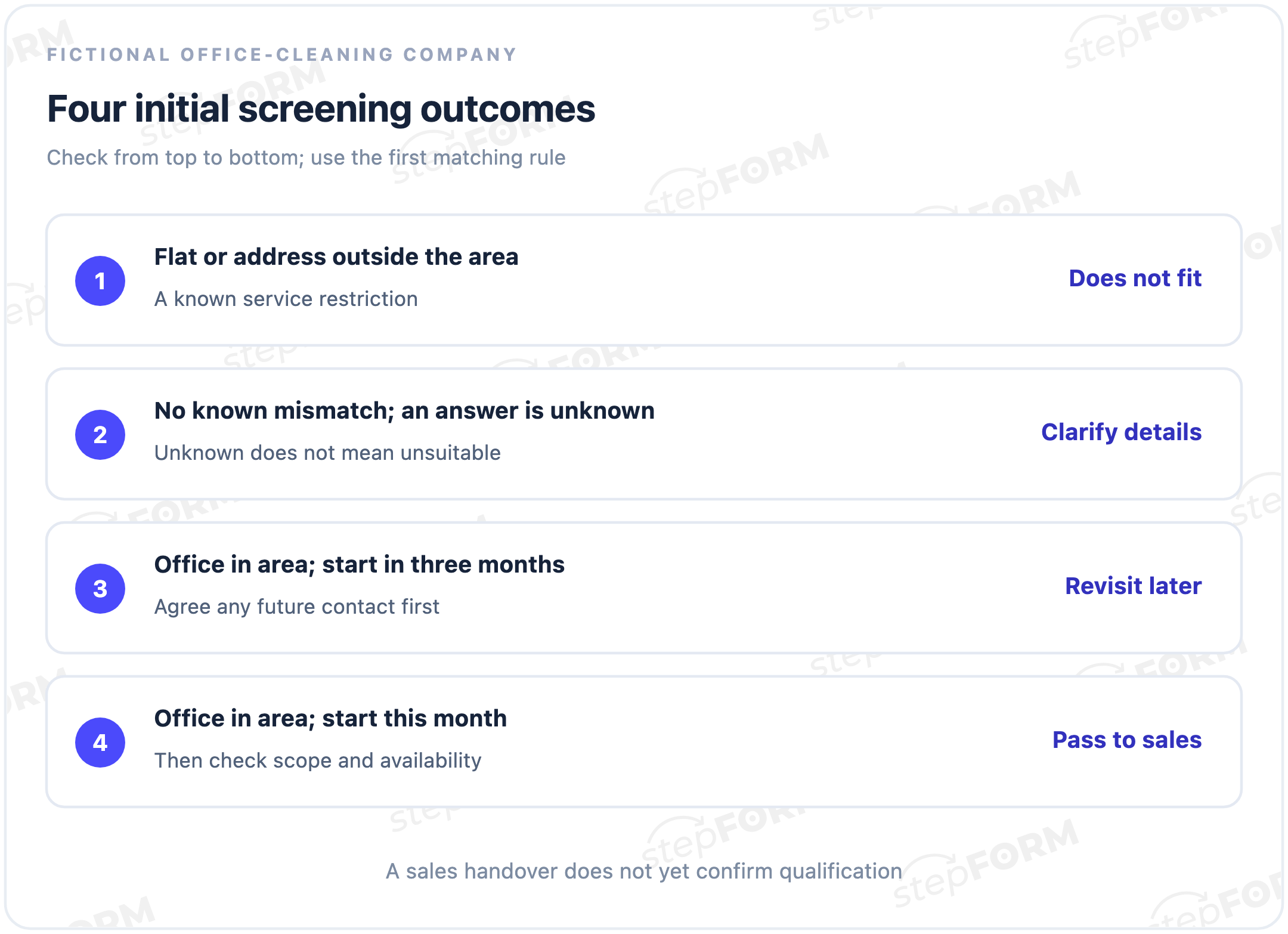
| Form responses | Initial outcome | Next action |
|---|---|---|
| Office, inside the area, this month | Pass to sales | Check scope, team availability and order terms |
| Office, inside the area, in three months | Revisit later | Agree whether to make contact nearer the start date |
| Flat, inside the area, date unknown | Service mismatch | Explain that the company cleans offices |
| Office, area unknown, this month | Clarify details | Check the address instead of rejecting the request |
Passing the enquiry to sales does not confirm qualification. The team still needs to understand the job, confirm that the company can carry it out and check that the person wants to discuss an offer. If no cleaning team is available on the requested dates, an enquiry that fits the form criteria will need a different decision.
What should the form ask?
Give each question a purpose. “What type of premises need cleaning?” separates services. “When would you like to start?” helps plan the conversation. If a detailed company history changes no decision and does not help the reply, you can leave that question out.
A quiz can gather details across several steps, but the number of screens does not determine screening quality. If two questions and a contact field are enough, extra compulsory fields just add work for the visitor. Explain why you ask about budget: to suggest a suitable option, not to judge someone's financial standing.
Keep unknown answers distinct. Do not replace them with zero, a rejection or the lowest budget band. Otherwise your rule evaluates an assumption instead of the person's response.
Logic jumps can hide irrelevant questions or change the route through a form, as described in the stepFORM documentation. Before launch, test combinations of answers, returning to an earlier step and changing a selection. Include a route for cases where information is missing.
How is qualification different from scoring?
Lead scoring assigns points to prioritise enquiries. Qualification checks the chosen conditions and determines the next step. You can use both. Essential restrictions still need to apply independently of the points total.
Suppose an urgent start gives a lead high priority, but the address is outside the service area. Extra points for urgency cannot change the address. Check essential conditions first, then prioritise suitable enquiries. Each point should have a reason linked to a decision. An arbitrary scale only creates the appearance of precision.
What should accompany a lead?
A useful record contains the original responses, the assessment, its reason and the date. For example: “Service area not confirmed: the person does not know whether their address is covered.” A label such as “bad lead” neither helps the next person reply nor reveals which rule might be wrong.
- Owner. The person who checks the enquiry and follows up on missing details.
- Next action. Discuss the job, verify the address or make an agreed contact later.
- Status reason. The condition that was met or failed.
- Criteria version. The rules used to reach the conclusion.
Responses can become outdated: a customer moves the start date, the cleaning team is booked or the scope changes. Review the assessment when that happens. If you send data to a CRM, check receipt and status-assignment rules separately. A response can be saved in the form without reaching the other system.
How to calculate a qualification rate
Define the group of enquiries and the reporting date. In this fictional example, the company receives 20 unique, genuine enquiries in a week. By the reporting date it has initially reviewed 15: six meet the team's qualification criteria, four are deferred, three do not fit and two need clarification. Five have not been reviewed.
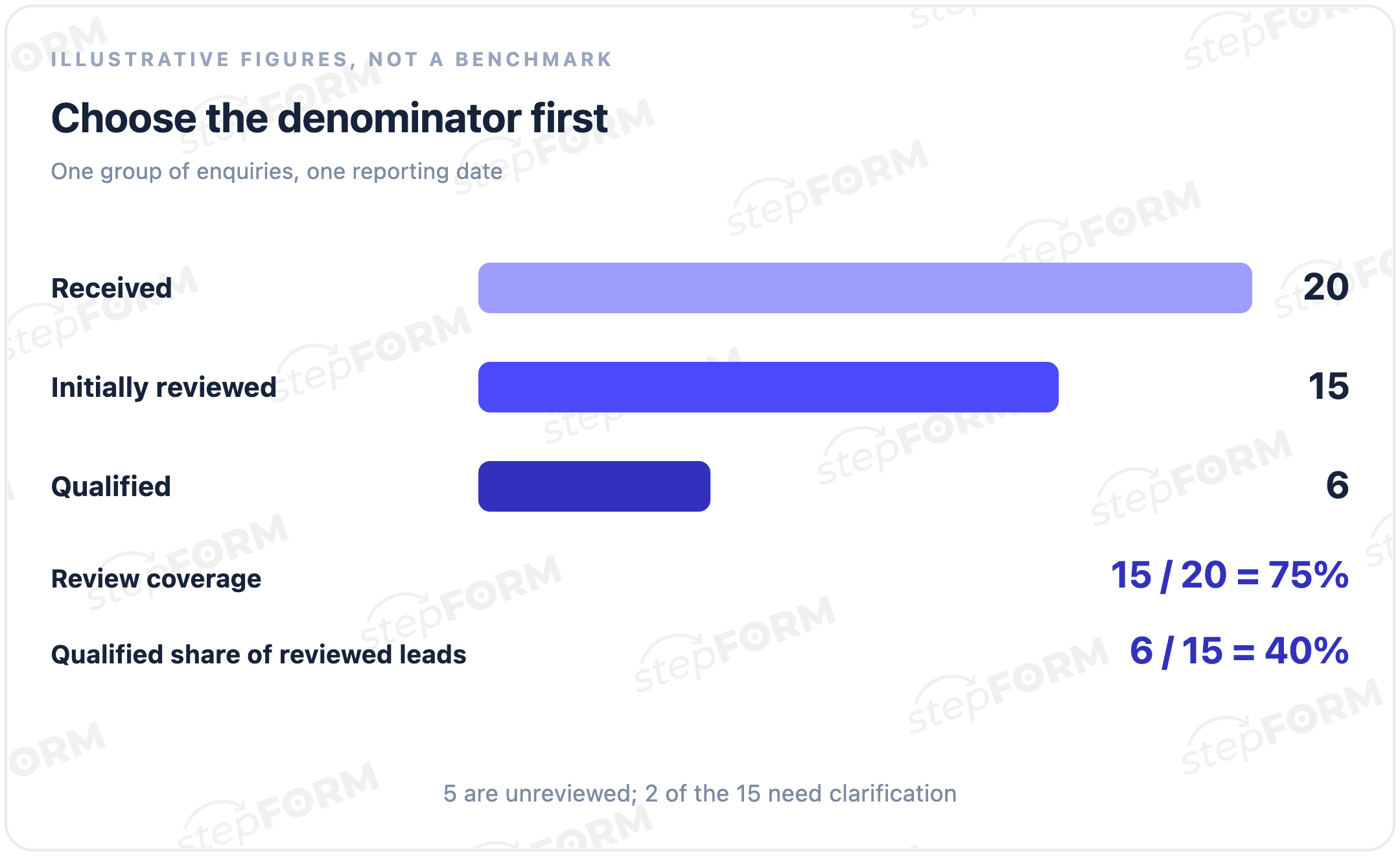
Initial review coverage is 15 / 20 × 100% = 75%. The qualified share of reviewed leads is 6 / 15 × 100% = 40%. Dividing six by all twenty gives 30%, but that measures confirmed qualified leads across the whole group, including enquiries nobody has reviewed yet.
Show how many enquiries still need review or clarification, and label the denominator. You cannot fairly compare 40% of reviewed enquiries from one channel with 30% of all enquiries from another. The result may change after the remaining five are assessed. Exclude spam, test submissions and duplicates using an agreed rule, not to improve the percentage.
These figures are not an industry benchmark or proof of a return on investment. Form conversion measures lead capture, qualification measures fit, and sales need a separate count.
Common screening mistakes
- Equating a contact with buying intent. A submitted form confirms an enquiry, not acceptance of the terms of a deal.
- Rejecting everyone without a budget. The person may need a cost estimate before spending can be approved.
- Treating a later date as a rejection. A suitable job can be non-urgent. Agree on any future contact first.
- Assigning unexplained points. A high total cannot remove a failed essential condition.
- Never checking rejected enquiries. An incorrect service-area rule can exclude the very customers the company needs.
When criteria change, keep the previous version and review some borderline cases manually. Has the qualified share increased? The enquiries may be a better fit. But looser criteria or incomplete review could produce the same rise. The percentage alone cannot tell you which explanation is right.
Where stepFORM helps
The stepFORM sales funnel builder lets you collect answers about a request and pass them on for follow-up. A form supplies information for qualification. The decision, the sales representative's responsibilities and statuses in a connected CRM must be defined separately. The builder cannot confirm a purchase on the customer's behalf.
Frequently asked questions
What is a qualified lead?
A potential customer who has been assessed and meets a company's defined criteria. Specify who confirmed the result: marketing or sales. Initial form screening alone does not provide that confirmation.
Can a lead be qualified before a call?
Some conditions can be checked from form responses, such as service type and location. Unknown information and conditions requiring confirmation still need further review.
What should happen to an “I don't know” answer?
Keep it as unknown and decide what needs checking. It is not a negative response or a reason to automatically reject an enquiry that fits the other conditions.
Does every form need BANT?
No. It is a guide to discussing budget, decision-making, need and timing. Choose questions for the service and the stage of the enquiry, rather than requiring four fields.
Are lead scoring and qualification the same?
No. Scoring assigns points to assess priority. Qualification checks fit against conditions. Both can be used, provided essential restrictions remain separate from the points total.
What is a good lead qualification rate?
There is no universal benchmark. Define the criteria, group and denominator before comparing similar periods. A high qualified share alone does not prove more sales or profit.