How to Build a Sales Funnel Online Without Losing Leads After the Form
How to build a sales funnel online: the stages, a template, a quiz example and what to measure. stepFORM data shows a third of forms send leads nowhere.
How-to  Daria Lisovenko
23 September 2026
Reading time ≈ 13 min.
Daria Lisovenko
23 September 2026
Reading time ≈ 13 min.
An online sales funnel is the chain of steps a person takes from an ad click to a payment: a page, a quiz or form, a lead, a reply from your team, a deal. Building one means connecting those steps and counting how many people you lose at each. Most funnels break not where people draw them, but right after the Submit button.
People who search for "sales funnel" usually want one of two things. Some need a diagram for a slide deck. Others need a working mechanism that brings in customers. The diagram takes five minutes. The mechanism takes longer, and this guide is about it: which stages you need, what to measure at each, where leads usually go missing and how to build it in a form builder.
The short version
Take the customer's path and split it into stages: visit, interest, lead, reply, payment. Every stage needs its own tool and its own number. The tool decides what the person sees; the number shows how many moved on. Once you have the numbers, it is obvious which link to fix first.
The weakest link is usually not the page or the form but what happens to a lead after it is sent. In our data, for a third of forms that collect a phone number or email, nobody receives the lead at all: it sits in the dashboard until the owner happens to look.
What a sales funnel means in practice
The classic picture is wide at the top and narrow at the bottom: many people hear about you, a few buy. It is honest but useless until it has numbers in it. A working funnel differs in three ways.
- Every stage has a definition you can count: not "interest" but "opened the quiz"
- The stages are connected technically: a lead from the form reaches whoever handles it on its own
- Every transition has an owner: who replies, how fast, and what happens next
You can draw a funnel diagram in any editor, including from the table below. The value is not in the drawing, though, but in having a number on every transition between stages.
A sales funnel template: stages and what to count
This template suits products and services whose price depends on parameters: renovation, custom furniture, construction, training, events. Copy it and swap in your own stages.
| Stage | What happens | What to count | What builds it |
|---|---|---|---|
| 1. Visit | The person arrives from an ad, search, social or a QR code | Visits by source | UTM tags, analytics |
| 2. Interest | Opens the quiz or calculator | Share who open it | An analytics goal on opening |
| 3. Engagement | Answers the questions and reaches the end | Share who finish | A quiz with logic jumps |
| 4. Lead | Leaves a contact, sees a price or a match | Leads and their source | The form, hidden fields |
| 5. Reply | Someone on your team contacts the customer | Share replied to within an hour | Telegram, CRM, auto-reply |
| 6. Payment | The customer pays a deposit or in full | Share who pay | Payment in the form, CRM |
Here is what such a funnel looks like with numbers. The example is illustrative, but the proportions are typical for services where people take time to decide.
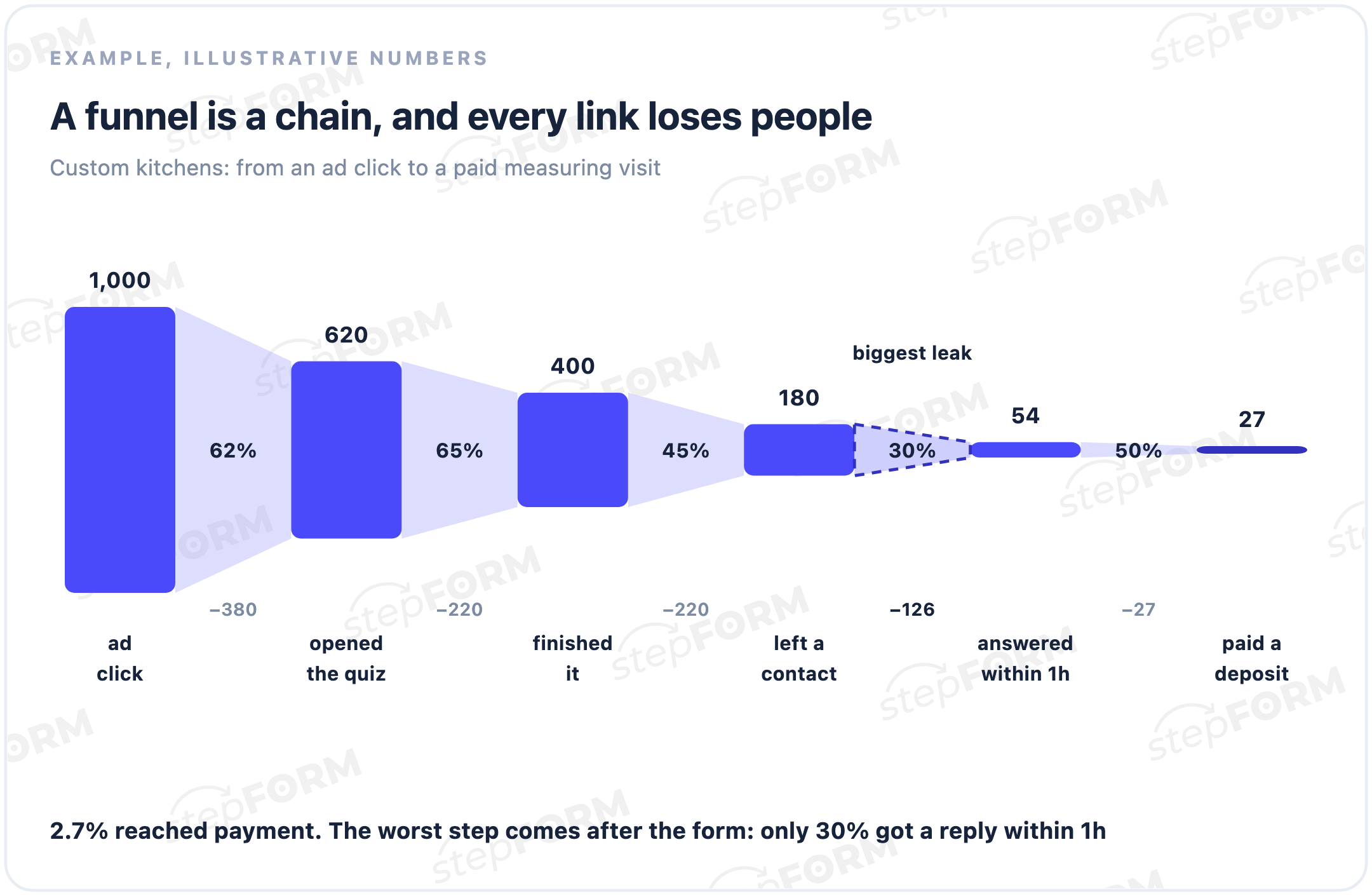
Notice one detail. In absolute numbers, most people leave at the first step: of a thousand visits, 380 never opened the quiz. That is normal; there are always more people at the top. What matters is the share. The worst transition here is from lead to reply: only 30% of leads got an answer within an hour. Those people had already left a phone number, so they were ready to buy, and they were lost.
Where to get the numbers for each stage
A template is useless if you do not know where the numbers come from. These sources are enough to start.
| Transition | Formula | Where the numbers are |
|---|---|---|
| Visit → interest | opened the quiz / visits | Analytics: page visits and a goal on opening the form |
| Interest → engagement | finished / opened | Analytics goals on steps or the form's completion report |
| Engagement → lead | leads / finished | The form's responses |
| Lead → reply | replied within 1h / leads | Your CRM or a manager's log with reply times |
| Reply → payment | paid / replied to | CRM, payment provider |
Count over the same period and for one traffic source at a time. A funnel from ads and a funnel from search behave differently, and one blended number hides both. Use at least a month and do not draw conclusions from a dozen leads: five of ten and five hundred of a thousand are both 50%, but with very different certainty.
In the first month the aim is not perfect numbers but spotting the weakest transition. It usually shows up even in rough data.
Where funnels actually break
We looked at where leads from stepFORM forms go. We took forms that collect a phone number or email and received leads in the last 90 days, and checked which notifications fire for them.
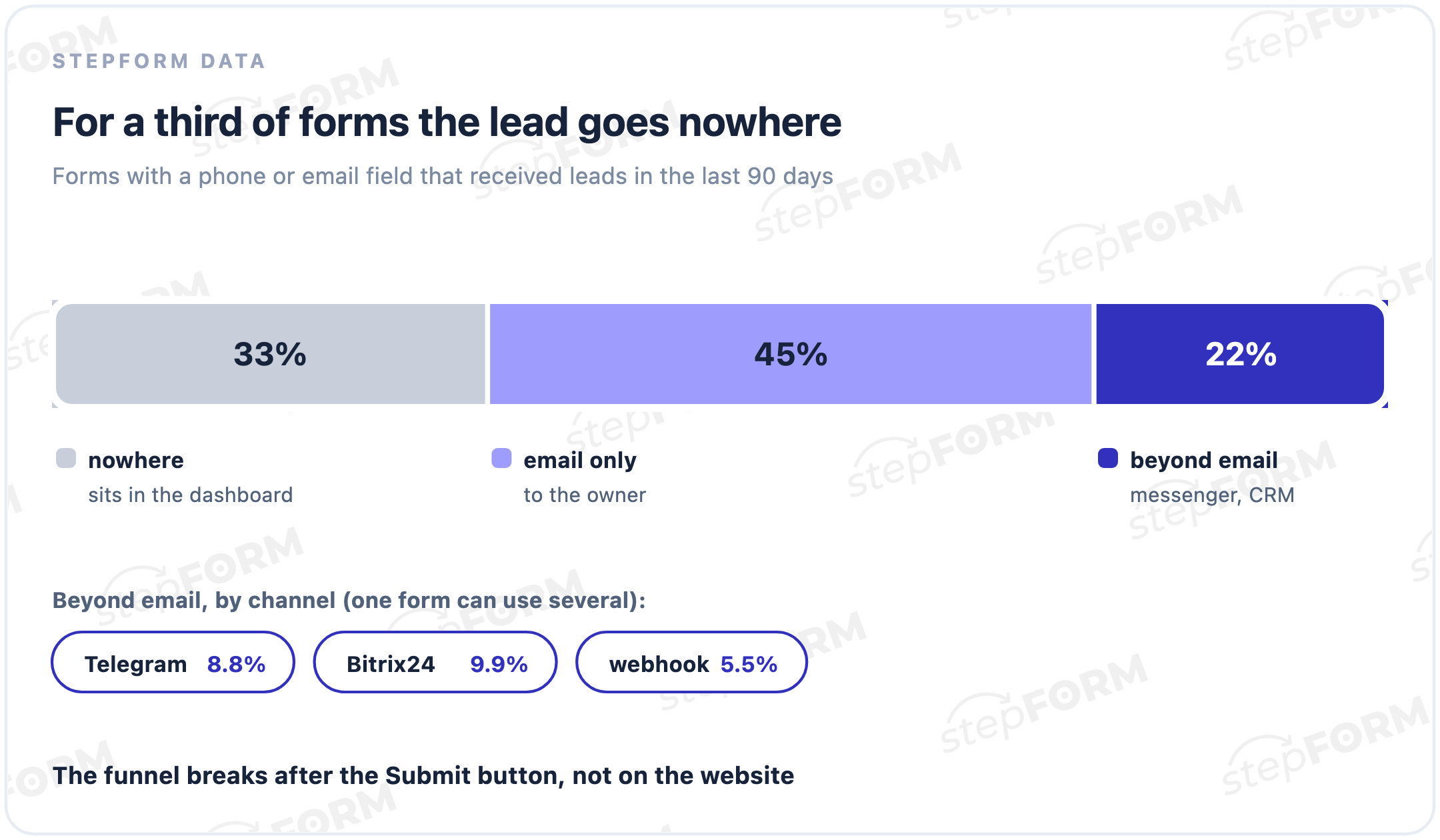
For 33% of these forms, nothing goes out after submission: no email, no Telegram message, no Bitrix24 deal, no webhook. The lead is saved in the responses and waits. For 45% it arrives by email only. Just 22% pass it beyond email, to a messenger or a CRM. Separately, Telegram is used by 9%, Bitrix24 by 10% and webhooks by 6%; one form can use several at once. An auto-reply to the customer is switched on for 9%.
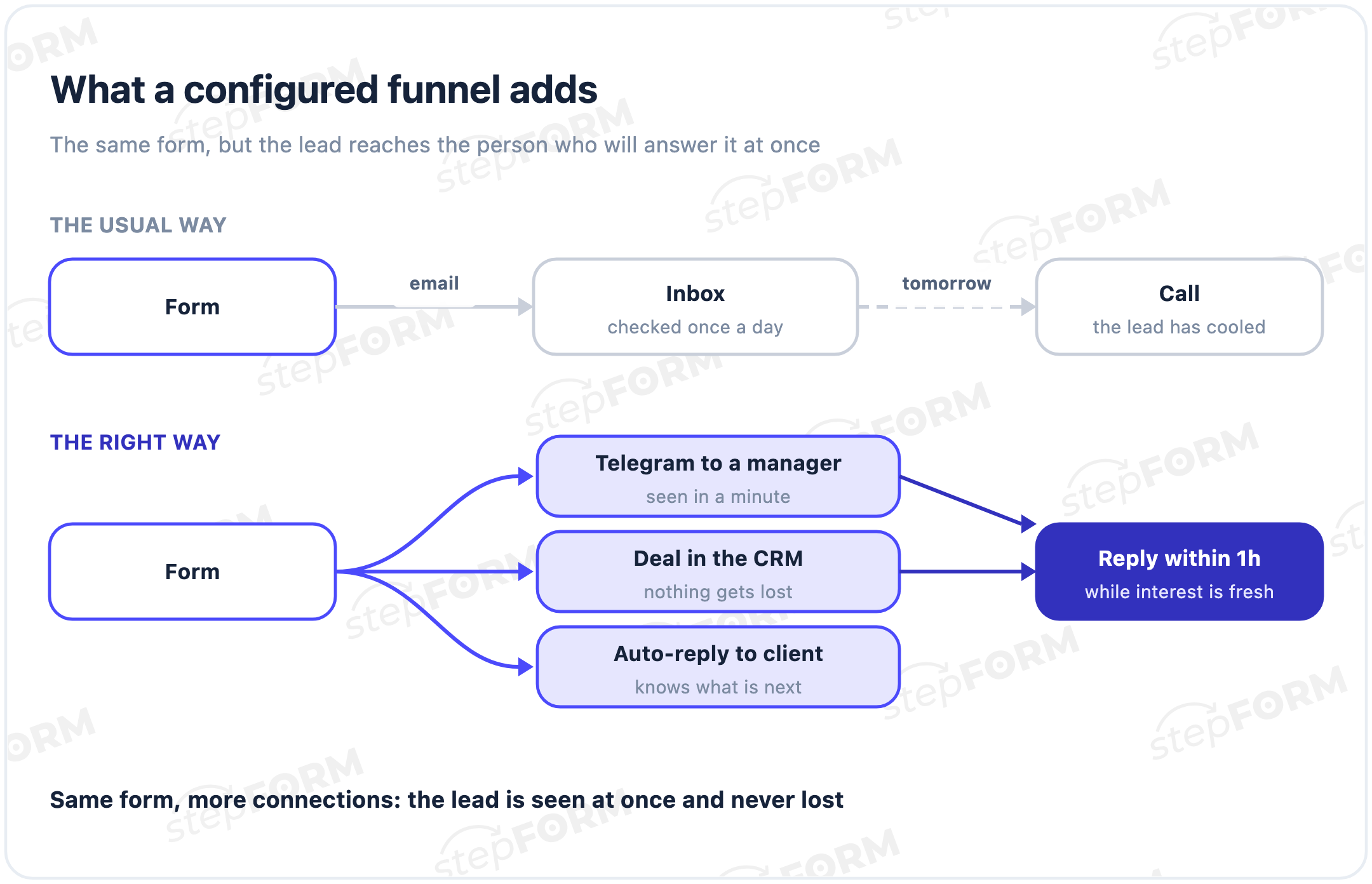
Email on its own is not the problem. The problem is that the inbox gets checked once a day, while a person who just left a lead cools down within hours. They have already contacted two other companies, and the one that calls first wins.
How to build the funnel in stepFORM, step by step
Here is the build order with plan limits in mind. The limits were checked against the stepFORM pricing page on 22 September 2026.
- Decide where people enter the funnel. A form or quiz can be embedded in a page or shared as a direct link. The link goes into ads, social profiles, messengers and QR codes, so you do not even need a website.
- Separate the people who need you from everyone else. A quiz with logic jumps asks different people different questions and shows them different offers. How to build one for free is covered in a separate guide.
- Show a price or a match before asking for the contact. A formula calculates the cost from the answers. A person who has seen a number leaves a phone number more willingly than one who was promised "we will call and explain".
- Collect the contact and consent. A phone or email field on the last step, plus a consent checkbox.
- Deliver the lead to whoever will answer it. Email notifications work on every plan. Bitrix24 from the Beginner plan. Telegram and webhooks to your own system on Pro. The notification address has to be verified, otherwise the emails never arrive.
- Reply to the customer at once. An auto-reply after submission, from the Beginner plan, tells the person the lead arrived and when to expect contact. It removes the anxiety and buys you a couple of hours.
- Take the payment or a booking. When the price is known, payment can be taken inside the form through Stripe, PayPal and other providers on the Pro plan. The full scenario is in the guide to a quiz with pricing and payments.
- Count every transition. Connect Google Analytics goals, from the Beginner plan. To know which page a lead came from, add a hidden field holding the page address.
A note on UTM tags. To carry the source from an ad link into the lead, you add a Code element to the form with a small script that copies the URL parameter into a hidden field. Adding your own code is only available on the Pro plan, so plan for it in advance.
Example: a funnel for custom kitchens
Let us walk through the funnel from the diagram and decide what to fix.
Entry. Ads lead to a standalone page with a quiz, "Price your kitchen to your measurements". Of a thousand visitors, 620 opened the quiz. That is a normal share for paid traffic. The ad headline could be improved, but it is not the main problem.
Quiz. Five questions: kitchen layout, dimensions, fronts, worktop, timing. 400 of 620 reached the end. When a quiz runs past seven questions and half of them do not affect the price, the share usually drops; that is not the case here.
Lead. The final screen shows a price range and asks for a phone number to send an exact quote. 180 of 400 left one.
Reply. Leads go to a shared inbox that the manager checks in the morning and after lunch. 54 of 180 leads got a reply within an hour. That is 30%, the worst transition in the whole funnel.
Payment. Of those who got a fast reply, half paid a deposit for a measuring visit: 27 people.
What is free and what needs a paid plan
| Funnel link | Free plan | Available from |
|---|---|---|
| Quiz with logic jumps | yes, up to three pages | up to 10 pages on Beginner |
| Price formula | yes, up to three conditions | more conditions from Beginner |
| Email notification | yes, one recipient | up to three recipients on Beginner |
| Auto-reply to the customer | no | Beginner |
| Bitrix24 | no | Beginner |
| Google Analytics | no | Beginner |
| Telegram, webhooks, SMS | no | Pro |
| Payment in the form | no | Pro |
| Your own code, including for UTM | no | Pro |
Every new account gets seven days of the Beginner plan, which is enough to build the whole funnel and test it with sample leads.
Can you build a sales funnel with AI?
Partly. An AI model is good at the words: it will suggest offers for the first screen, draft quiz questions and write the auto-reply. That saves time on first drafts.
A funnel, though, is made of connections rather than words: where the lead goes, who answers it and within how many minutes, whether each transition is counted. Those connections have to be set up by hand and tested with a sample lead. Judging by our data, they are exactly what is most often missing.
Common mistakes
| Mistake | What happens | What to do instead |
|---|---|---|
| The lead stays in the dashboard only | Someone finds it a day later, or never | Notify the person who replies |
| The notification email is not verified | No emails arrive, so it looks like there are no leads | Verify the address and send a test lead |
| Fixing the top of the funnel | Money goes into ads while leads leak at the bottom | Compare transitions by share |
| No source on the lead | You cannot tell which ads bring customers | A hidden field or UTM tags |
| Contact before value | People close the quiz on the first step | Show the price or match first, then ask for the phone |
Frequently asked questions
Where do I start building a sales funnel?
With the customer's path. Write down the steps from first contact to payment, define what success means at each one, and only then choose tools. Otherwise you end up with services that are not connected to each other.
Is there a ready sales funnel template?
Yes, this guide has a six stage table: visit, interest, engagement, lead, reply, payment. Each stage lists what to count and what builds it. Swap in your own stages if you sell differently, for example without a deposit.
Which funnel stages matter most?
The ones that lose the largest share of people, not the largest number. The top of the funnel always loses the most people simply because there are more of them. The worst step often comes after the form: the lead was left, but the reply came late.
Do I need a CRM for a sales funnel?
Not at the start. The minimum is a notification to whoever replies and a clear reply time. A CRM becomes necessary when leads pile up and you cannot afford to lose any or need to see where each deal stands. stepFORM can send leads to Bitrix24 or to any system through a webhook.
How do I know which ad a lead came from?
Add a hidden field with the page address, or copy UTM tags from the link into a hidden field with a Code element. The second method needs the Pro plan, because adding your own code is only available there.
Can I build a funnel for free?
The core, yes: a quiz with logic jumps up to three pages, price calculation and email notifications are on the Free plan. Auto-replies, Bitrix24 and Google Analytics come with Beginner; Telegram, webhooks and payments with Pro.
How is a funnel different from a landing page?
A landing page is one page, the first stage of the funnel. The funnel also covers what happens next: the quiz or form, lead delivery, the reply and the payment. A great landing page will not help if nobody receives the leads it produces.
How fast should I reply to a lead?
The faster the better, while the person remembers what they asked and has not contacted competitors. Aim for within an hour during working hours. An instant auto-reply buys time when the team is busy.