How to write a USP you can back up
Learn how to write a unique selling proposition with six illustrative examples, a seven-field worksheet and checks for evidence, relevance and customer understanding.
Guides  Daria Lisovenko
8 October 2026
Reading time ≈ 17 min.
Daria Lisovenko
8 October 2026
Reading time ≈ 17 min.

A unique selling proposition, or USP, explains why a customer should choose your product or service over the available alternatives. It needs a difference the buyer values and facts that support it, because words such as "Quality, speed and affordable prices" could just as easily appear on a competitor's website.
Six business examples · Your USP worksheet · How to check the offer
Imagine someone comparing custom wardrobes. They worry that delivery, assembly and other work will be added to the initial price after the measurement visit. For this person, knowing exactly what the quote includes might matter more than a claim about "premium furniture." First check whether the company actually works under those terms and whether they differ from the options the buyer is considering.
You cannot pull a USP out of an attractive adjective. Compare offers, talk to customers and examine the documents used to fulfil an order. In the wardrobe example, those documents are quotes: without their scope, debating "great value" or "transparent pricing" is still a debate about words.
A USP, an offer and a slogan have different jobs
Shopify describes a USP as a focused statement of what sets a product or business apart. For your own draft, check both the difference and its relevance to the customer, then look for evidence. A specific sentence can still describe a feature the buyer does not value or a service every alternative provides.
| What you are writing | The question it answers | Illustrative example |
|---|---|---|
| USP | Why choose this particular offer? | The wardrobe quote includes delivery, assembly and packaging removal |
| Offer | What can I buy, and on what terms? | A made-to-measure wardrobe, with the scope and price agreed after a measurement visit |
| Slogan | What phrase should I remember about the brand? | A place for everything |
| Call to action | What should I do now? | Request a quote |
The first row becomes a USP hypothesis if those included services matter to the buyer and distinguish the company from the alternatives in their comparison. At this stage, we only know what the service includes. An offer can be an ordinary purchase at a stated price, with no short-lived promotion involved. A discount may be part of the offer, but the discount alone does not explain a lasting difference between businesses.
A slogan can convey a mood or an image. A USP gives someone a reason to choose. The two roles can share a sentence if its meaning remains clear, but do not expect "A place for everything" to explain a quote and the terms of assembly.
Leave the button to do its own job. Our guide to calls to action covers the next step, while this article develops the argument someone reads before clicking.
Where to look when the products seem alike
Start with one buying situation. "Our customers want good service" gives you little to work with. "A small store owner needs an accountant who understands returns on their marketplace" identifies a problem to discuss. A family choosing a wardrobe and a contractor ordering furniture for a building project may judge the same manufacturer against different requirements.
The Strategyzer Value Proposition Canvas maps the tasks, difficulties and desired results of one customer segment. Use it to prepare a USP, with the understanding that the statements you write down begin as assumptions to check, not evidence of uniqueness.
Ask customers about the last real choice they made. Which options did they consider? What did they compare, where did they hesitate, and why did they reject the other options? "Is a personal approach important to you?" puts an agreeable answer into the question. If the customer says a departure from the standard process influenced their choice, ask what happened and what the provider actually did.
Look beyond the competitors on the first search results page: someone might do the work themselves, keep their existing solution, buy a ready-made item instead of a custom one or postpone the purchase. A wardrobe for a rental apartment needed for one year may be compared with ready-made furniture or temporary storage. A list of expensive cabinetmakers could miss that decision.
For each option, record the terms that affect the customer's task, using public offers and documents you obtained legitimately. Compare the same scope of work: a price excluding assembly and one including assembly describe different purchases. If a competitor's website does not mention a service, that does not prove the service is unavailable.
| Possible source of a reason to choose | What to check inside the business |
|---|---|
| Service scope | Which necessary tasks are included, and which cost extra? |
| Specialism | Which customer problems and constraints can the team actually handle? |
| Working process | What is agreed before work starts, and what document does the customer receive? |
| Timing or stock | Which orders qualify, and what event starts the clock? |
| Verifiable outcome | What can you show before purchase: a sample, specification, report or demonstration? |
Check promises with the people who fulfil the order. Marketing writes "We dispatch today," while the warehouse accepts same-day dispatch requests only before noon. That condition affects who can use the service. Leave it out and the promise reaches people whose orders the company cannot handle on the advertised terms.
If you find no meaningful difference, do not write "the only company" to create one. Explain the actual terms and identify what could change in the product or service. I would rather publish an ordinary offer that customers can understand than manufacture uniqueness, because they will eventually encounter how the company works.
Build the wording from facts
Choose one argument tied to the customer's task. Work through the task, difference, evidence and conditions, keeping the supporting facts and limits in your notes before moving the relevant details onto the page.
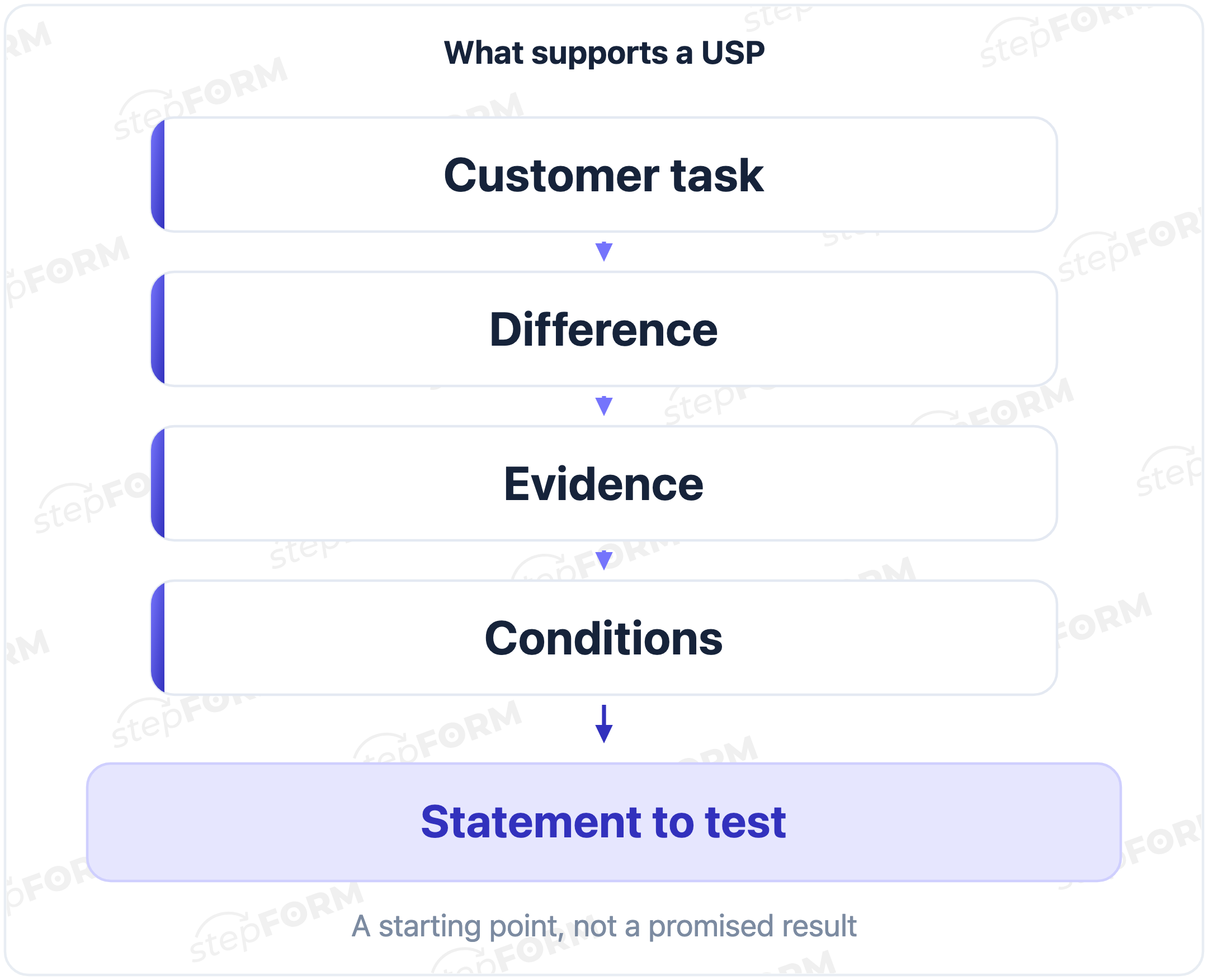
A first draft can use this structure: "For [customer and task], we offer [specific difference]. This is supported by [fact or document]. It applies [under these conditions]." This is a working template, not a required advertising formula. You do not have to print every bracket and explanation in the final headline.
Remove broad descriptions until you can name what they mean. "Fast" needs a real time period and a starting point. "Transparent" needs a breakdown of the price and a rule for changing it. Explain "professional" through experience with a particular task or a way of working the customer can see.
Do not add a number to make a sentence look convincing. If the team cannot confirm a time frame, you cannot borrow "24 hours" from a compelling example elsewhere. Find out what the business can deliver, or describe the process honestly without a numerical promise.
Six USP examples for products and services
Every business, condition and sentence below is illustrative. The examples examine how specific a promise is, with no advertising campaign results behind them. Each statement remains a USP candidate until you check its relevance and difference in your own market. Reuse the reasoning. The invented capability is not yours to claim.
A custom wardrobe with a clear quote
The original claim is "Quality furniture at an affordable price." In this illustrative business, the quote includes delivery, assembly and packaging removal, while new work requires a separate agreement.
A more specific version: "A wardrobe made to your measurements, with delivery, assembly and packaging removal included in the quote." Show a sample that lists the work, and explain that a change to the order requires fresh agreement. You cannot drop this condition to promise a permanently fixed price for any order.
The argument concerns predictable expenses. If every other workshop the buyer considers includes the same services, the sentence still explains the purchase, but it does not distinguish this company on its own.
Laptop repair after the price is agreed
"Fast, reliable repairs" does not address the fear of a bill for work the customer never ordered. Suppose the workshop charges a diagnostic fee, then gives the repair price and waits for approval.
The candidate: "We agree the price of your laptop repair with you before work starts. Diagnostics are charged separately." Show the diagnostic price list and the approval process. Since the diagnostic fee remains payable if the customer declines the repair, shortening this to "Only pay for results" would change the terms.
A course with feedback on a project
Replace "Modern training from experts" with the format this illustrative course provides: the learner completes a project, and the instructor supplies written comments on it.
"Build a practice project and receive written feedback from your instructor." Show a sample assignment and anonymised comments to explain what "feedback" means, with separate permission to publish someone else's work. The sentence promises neither employment nor a graduate's income.
A project could be an unnecessary burden for someone who only wants an overview of the topic. Choose the audience with that in mind. The same course format can help one person and discourage another.
Accounting for a small online store
"All accounting services for your business" leaves the store owner to work out whether the team can handle their returns and settlements. This illustrative accounting service works with small stores and an agreed list of systems.
"Accounting for small online stores: sales and returns across supported marketplaces." Keep that list visible. Name the supported systems and operations, state what the service excludes, and show an anonymised sample report.
The specialism has a boundary: there is no promise to know every marketplace. The transition time is determined after reviewing the existing records, so do not attach an instant setup promise when that requires separate work.
Supplies with a specific dispatch rule
The supplier writes "Always in stock, with fast delivery." In this example, only standard items are held in stock, and the warehouse dispatches an order on the same business day if it is received before 12:00.
"Standard supplies in stock: orders received before noon on a business day are dispatched that day." Display current stock information, the order handling rule and delivery terms beside the claim. Dispatch is not delivery. Explain the different process for made-to-order items and requests received after noon.
A photography studio with included lighting
"Everything for the perfect shoot" promises too much. This illustrative studio includes studio flash lighting from a published equipment list in its hourly hire fee, while other equipment costs extra.
"Studio flash lighting included in your hourly hire." Provide the list, the studio hire rate and the extra charges for other items. The photographer can compare what is included rather than guess what "everything" means.
Across these six examples, the change in wording is visible without a sales report: the customer can see what is being offered. A claim that the new USP increased enquiries would need a separate test.
When a specific term actually sets a company apart
Suppose the buyer in the wardrobe example has gathered three quotes for the same order. Words such as "premium" or "great value" do not show the difference in scope. Put the documents into the same structure.
The terms of all three workshops in this table are entirely invented. It shows a comparison method, not research into the furniture market.
| Workshop | Included in the quote | Handled separately |
|---|---|---|
| A, from our example | Wardrobe, delivery, assembly and packaging removal | New work following a change to the order |
| B | Wardrobe, delivery and assembly | Packaging removal and new work |
| C | Wardrobe | Delivery, assembly, packaging removal and new work |
"Assembly included" does not distinguish A from B. Included packaging removal sets A apart from the other two options in this illustrative comparison, but you still need to find out whether it matters to the buyer. It could be a weak argument for someone who will dispose of the packaging themselves and chooses by the total budget.
The table says nothing about which company is cheaper: there are no prices. It says nothing about every workshop in the city either. The conclusion concerns the scope of these three offers, which is why "Delivery, assembly and packaging removal included in the quote" is more honest than "The only company with no extra charges."
A seven-field USP worksheet
Copy these seven fields into a working document. Use one audience and one buying situation. Trying to fill them in for every service at once gives you a company profile rather than an argument for a specific choice.
- Customer and situation: who is choosing now, and why?
- Task: what outcome do they need, and what worries them?
- Alternatives: which offers or actions are they comparing us with?
- Difference: which condition or feature matters to that choice?
- Evidence: which document, sample or observable fact supports it?
- Limits: for which orders, time frames or situations does the promise not apply?
- Statement: how can we express the reason to choose without "best," "unique" or "personalised"?
In the completed illustrative wardrobe worksheet, the customer is furnishing a home they own and needs to compare the cost of a completed, installed wardrobe. Their alternatives include ready-made furniture and other workshops. Included delivery, assembly and packaging removal form the candidate difference, with a complete sample quote as evidence of the scope. Changes to the order require separate agreement. The resulting statement appears in the first example.
We still have no information about real competitors in that worksheet. The "Difference" field therefore needs checking. If the comparison reveals identical terms, look for another argument or use the sentence to explain the purchase without claiming uniqueness.
Now try the worksheet on "The fastest installation in town." What is being compared, over which period, against whom and for what scope of work? A quote with assembly included does not prove speed. Even if customers value a quick installation, a document about price cannot establish installation time: the worksheet exposes a sentence with no relevant support.
How to check a USP before and after launch
Understanding the wording tells you whether the reader interpreted it correctly. Checking the product establishes whether the business fulfils the promise, while comparing marketing results measures the response. These are three separate checks. One cannot replace another.
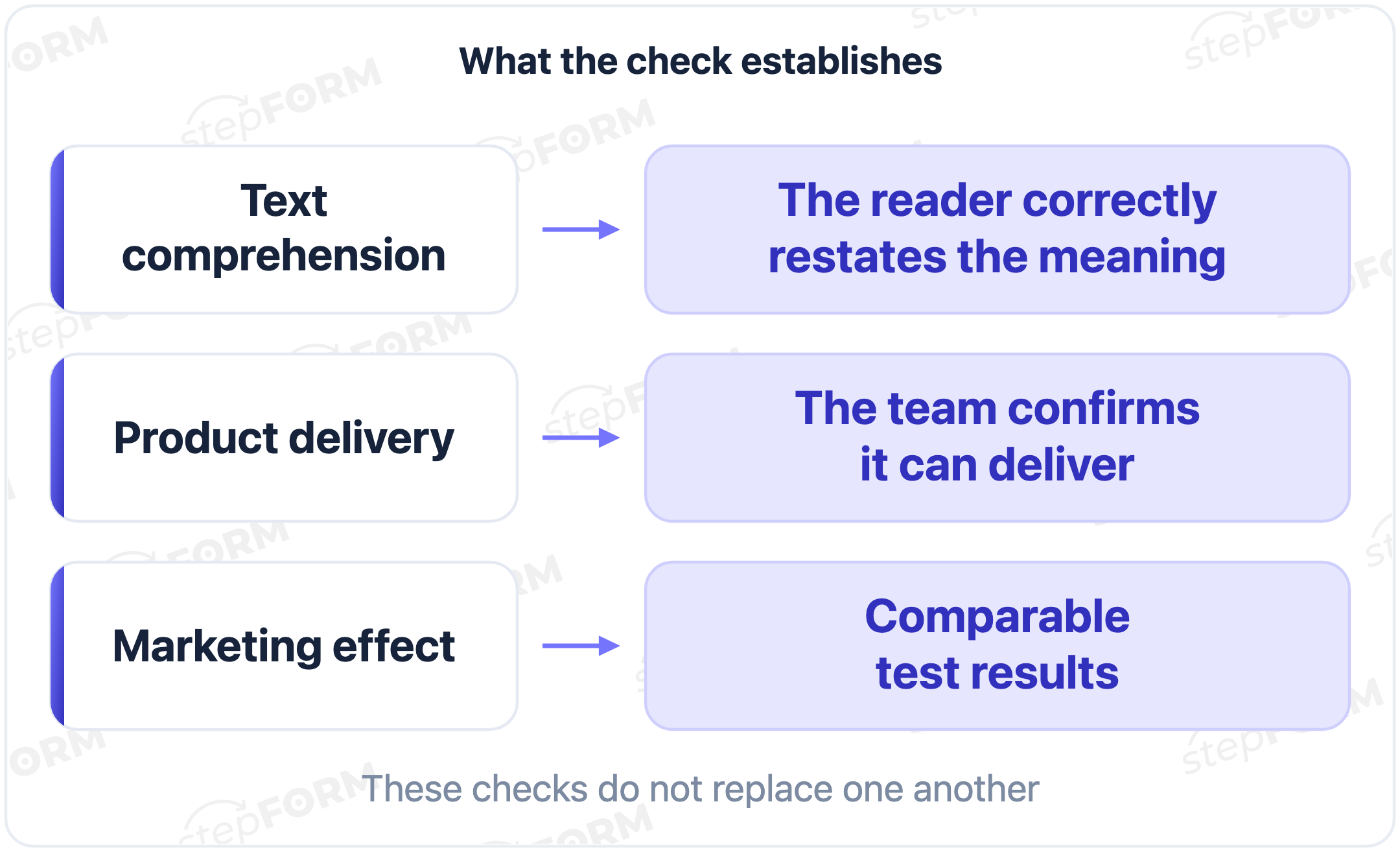
Show the page to people with the relevant task. Ask them to describe the offer in their own words: what the company provides, why it helps, which limits they noticed and what they would compare it with. Ask what they still need to make a choice. If you explain the text before they respond or correct them during the conversation, you are testing your own explanation.
Record misunderstandings. In the supplies example, check whether the reader takes same-day dispatch to mean same-day receipt of the goods. If they do, adjust the wording and the placement of the conditions. A few conversations can uncover a problem with the text, but they cannot measure how widespread that problem is across the market.
Separately, review the promise with the team. Find the supporting document, check exceptions and decide who updates time frames or stock information, bearing in mind that the rule must still hold after the team has moved on from the ad design. If warehouse conditions change, update the ad and page as well as the internal instructions.
Once the wording is clear and the business can fulfil it, you can test the response. To compare wording, keep the product, terms, audience and next step comparable. If you change the service along with its description, you are comparing two complete offers. That is a different question, though both kinds of test can be useful.
Choose the primary outcome and a stopping rule in advance. The outcome might be a suitable enquiry about this service. Where you can randomly assign comparable audiences to the variants, use that option. Comparing different weeks with different advertising traffic does not isolate the USP's effect. Do not announce a winner after the first purchase. The number of observations needed depends on your starting rates and the difference you want to detect.
A click records interest in visiting the destination. Submitting a form records an enquiry. Neither establishes that someone is ready to buy. Our lead generation guide explains that journey. If you have little data, keep the statement as a hypothesis and continue collecting observations without claiming proven growth.
Carry the offer through to the enquiry in stepFORM
Once you have found the argument, keep it visible along the path to an enquiry. The Message element in stepFORM lets you place text in a form, while input fields collect information about the request and a contact detail. The form builder documentation describes the available elements. The builder helps you present this step, without researching competitors or verifying that your business is unique.
For the illustrative wardrobe offer, put the sentence about the scope of the quote above the questions. Keep the condition about separately agreeing new work beside it. Ask for the parameters needed for an initial response and a way to contact the customer. Place the sample quote and full terms where visitors can see them before submitting.
Do not require a phone number to view the evidence you promised to show immediately. Contact details are for continuing a specific request. Our guide to a website contact form covers choosing fields and checking receipt of a response.
Complete the worksheet for one service, agree the promise with the team and build a form for that offer in stepFORM. Before advertising it, test the form separately from genuine enquiries: the wording and conditions are visible, responses are saved and the employee receives the request. Adding a USP above a form does not guarantee more sales.
Frequently asked questions
Can a business have more than one USP?
You can develop different arguments for different products or buying situations. Record who each one is for and which facts support it. Avoid incompatible promises about the same order, such as standard delivery from stock and making any custom version in the same time.
Does a USP need a time frame or a savings percentage?
No. Service scope, a clear approval process or a specialism can provide a specific argument too. A number helps when it has evidence, a unit, conditions and a basis for comparison. Do not add a percentage merely to sound convincing.
What if a competitor copies the statement?
Check whether the actual terms match or just the wording. If the offer has become standard among the alternatives your customer considers, revisit the argument and gather fresh information about their choices. Do not respond with an unsupported "Only we do this." Fulfilling the promise matters more than owning the words.
Can AI help write a USP?
Yes, by drafting wording from facts you have checked. Supply the audience, terms, evidence and prohibited claims. Ask it to list assumptions separately. The model does not know your actual time frames or verify that no similar offer exists in the market. Your team does those checks.
When should you review an existing USP?
When the product, fulfilment terms, buying situation or available alternatives change. Assign someone to keep promises current and check them before a new campaign. Even a previously successful test cannot make an outdated condition acceptable.