How to map a customer journey and find barriers to buying
Build a customer journey map around a real task. A filled service example, a reusable CJM template, and a way to turn customer barriers into tests.
Guides  Daria Lisovenko
16 October 2026
Reading time ≈ 16 min.
A customer journey map, or CJM, describes a customer's experience in a specific situation. It connects their actions, questions, and difficulties to their interactions with a business. The map helps you choose a change to investigate: explain what a price includes, stop asking for the same information twice, or make the next step clearer.
Picture someone booking an air conditioner installation. They read an ad offering a complete installation, open the website, and send their phone number. Later, they learn that some work costs extra. A report might record a lost lead. A journey map makes room for the question they brought to the purchase: what will the whole job cost? That gives the team something to investigate.
The example below follows this service purchase and includes a template you can reuse. The company and situation are fictional. This is a worked example of the method, not a customer study or a reported stepFORM success story.
What a journey map shows and when to use one
The map follows a customer trying to get something done. They encounter an offer, compare options, contact the company, receive the service, and decide whether to return. Their route may include repeat visits, a conversation with someone at home, and a message to the business, regardless of the order in which you arranged the sections on your landing page.
Journey mapping helps when a team can see a problem but disagrees about the explanation. Marketing suspects the ad. Sales says the leads are unprepared. Someone proposes a shorter form. Bringing together customer actions and evidence gives that discussion a firmer basis. A vague complaint about confused customers becomes a specific information gap.
NN/g's introduction to journey mapping describes an actor, a scenario, phases, actions, thoughts and emotions, and opportunities to improve the experience. You can adapt the format to the decision. A small business can use a table if its entries help the team decide what to do.
I would hold off on drawing a smooth emotional curve. A smile above the payment stage explains nothing unless you know what the customer said or did. An empty cell is better than an imaginary happy customer.
How a journey map differs from a funnel or segmentation
Segmentation helps you decide whose task to examine. A funnel measures the share of people who reach each stage. A journey map describes the experience within a scenario: what someone needed, what they found, and what got in their way. These tools work together, but each answers a different question.
Suppose inquiries fall. A funnel helps locate the change. A journey map suggests explanations to investigate: the page describes the price differently from the ad, the visit time is unclear, or the customer has to repeat information already supplied. Recording an explanation in a table does not establish that it caused people to leave.
Choose a customer group for a specific scenarioBe careful with internal CRM stages. Lead assigned to sales describes the company's process. The customer may experience nothing but silence after sending a request. Their entry on the map could be waiting for a reply. Perhaps they wonder whether the request arrived. You still need evidence for that question, from correspondence or a conversation with the person.
Use our separate sales funnel guide for stage-by-stage measurement. Here, the job is to understand the context in which those transitions happen.
Keep the current journey separate from the proposed one
A current-state map describes the experience as it exists. Observations, inquiries, order details, and customers' accounts supply its evidence. A future-state map describes a proposed experience. It helps a team discuss a new route, but it is not a record of what customers already do.
In our example, one current-state hypothesis is that visitors see a headline price without understanding possible extras. The proposed experience gives them a preliminary estimate, its scope, and its limits before they send a request. Without evidence, both statements remain assumptions, serving different purposes.
Save the original version, its date, and the scenario boundaries. If the team overwrites it with an attractive future journey, it loses the reason for the change, and an idea someone proposed may later look like a barrier someone actually observed.
Set the boundaries before filling the map
Describe the customer's task in one sentence. For this example: a homeowner wants to install an air conditioner they already own and understand what the installation includes. Buying a new unit and servicing an installed one sit outside the scope. Those tasks bring different questions, timing, and selection criteria.
Choose a starting event and an end point. Our map starts with finding an installer and ends with the first use after installation. Extend it if repeat business is the question. If you are only investigating how people arrange a visit, a detailed maintenance history will get in the way.
Write down the decision the map should support. For instance: find out what information people need before requesting an estimate. That keeps the work manageable. Increase sales is too broad. Almost any detail could fit, and the team may never settle on a change.
One purchase can involve several people. A homeowner might choose the terms while another household member speaks to the installer. Record those participants and the handoff between them, using related maps where they have separate tasks and routes rather than inventing a single customer who somehow speaks for everyone.
Where to find evidence when you have no formal study
Start with material the team can access: anonymized questions from messages, recorded reasons for declining, inquiry details, the published offer, and records of how orders were fulfilled, keeping a source and date for each important observation. Several messages from one customer are not several independent confirmations.
Ask recent customers to reconstruct a particular purchase. What happened before they started searching? Where did they compare installers? What did they need to know? What happened after sending the request? Asking whether your website is convenient steers the conversation toward judging the website. Reconstructing events gives you more material for the map.
Where possible, speak with people who declined or chose an alternative. Talking only to happy buyers leaves some difficulties out. A handful of conversations can uncover hypotheses, but it does not tell you how common those problems are across the whole audience.
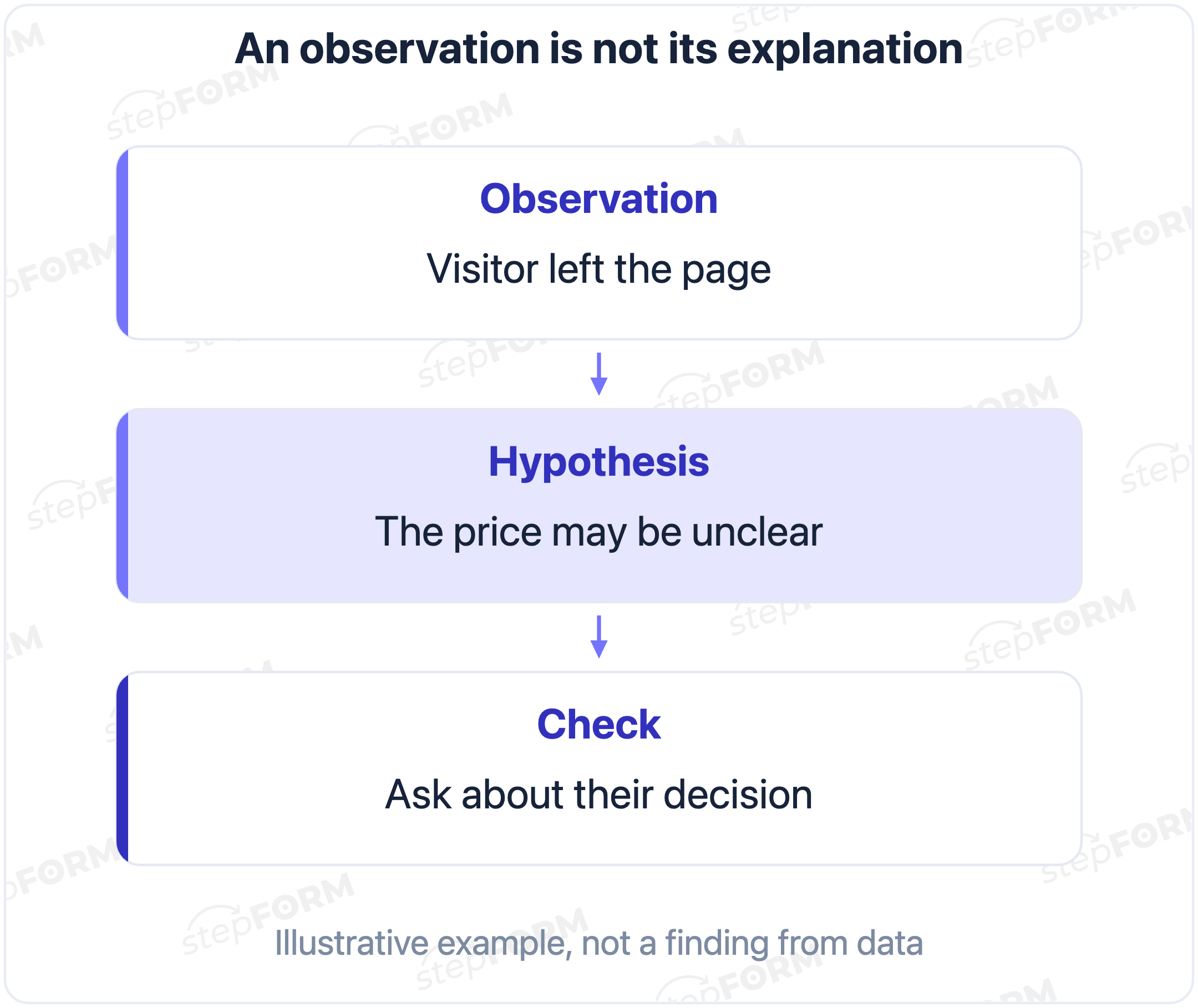
Analytics records the actions your measurement can capture. It does not report thoughts. Leaving an estimate page could reflect an unclear price, an interruption, comparison shopping, or a technical fault. Do not label the exit frustration without further evidence.
NN/g's guidance on creating journey maps stresses the need for research: quantitative data supports the picture but does not reconstruct the experience on its own. In your working table, separate an observation from the team's explanation and the question you still need to test.
A filled journey map for an installation service
This is a fictional worked example. The questions and barriers below were written to illustrate the method, not taken from interviews. The final column identifies evidence to seek before changing the website or the service process.
| Stage and action | Touchpoint | Question or possible barrier | Where to check |
|---|---|---|---|
| Finds an installer for a unit already purchased | Search, an ad, a recommendation | Do you handle my unit and work in my area? | Search queries and initial inquiries asking these questions |
| Compares the service scope | Service page and reviews | What does complete installation include? Why do prices differ? | Ad and page versions, questions asked before ordering |
| Checks a preliminary price | Calculator or conversation | I do not know the pipe length. Can I still get an estimate? | A manual walkthrough and customer conversations |
| Sends a request and arranges a visit | Form, confirmation, messages | Did my request arrive? Is the appointment confirmed or still to be agreed? | Confirmation copy, inquiry history, and the actual agreement |
| Accepts the completed work | Installer and final bill | Why is there an extra charge that was not explained earlier? | The agreed scope and reasons for a changed price |
| Uses the air conditioner after installation | Instructions and support channel | Who should I contact if something seems wrong? | Instructions supplied and questions after the job |
There is no required number of stages. Split price clarification if it contains several distinct episodes. Combine neighboring entries if they describe the same action and difficulty. Detail earns its place by helping the decision, not by making the table longer.
The emotional layer is deliberately blank. After a real conversation, you might add a feeling with a source: a customer reported worrying about extra charges, for example. Until then, it is an assumption, while the date, situation, and a reference to an anonymized excerpt will help keep one person's experience from becoming a claim about every buyer.
Turn one entry into a decision
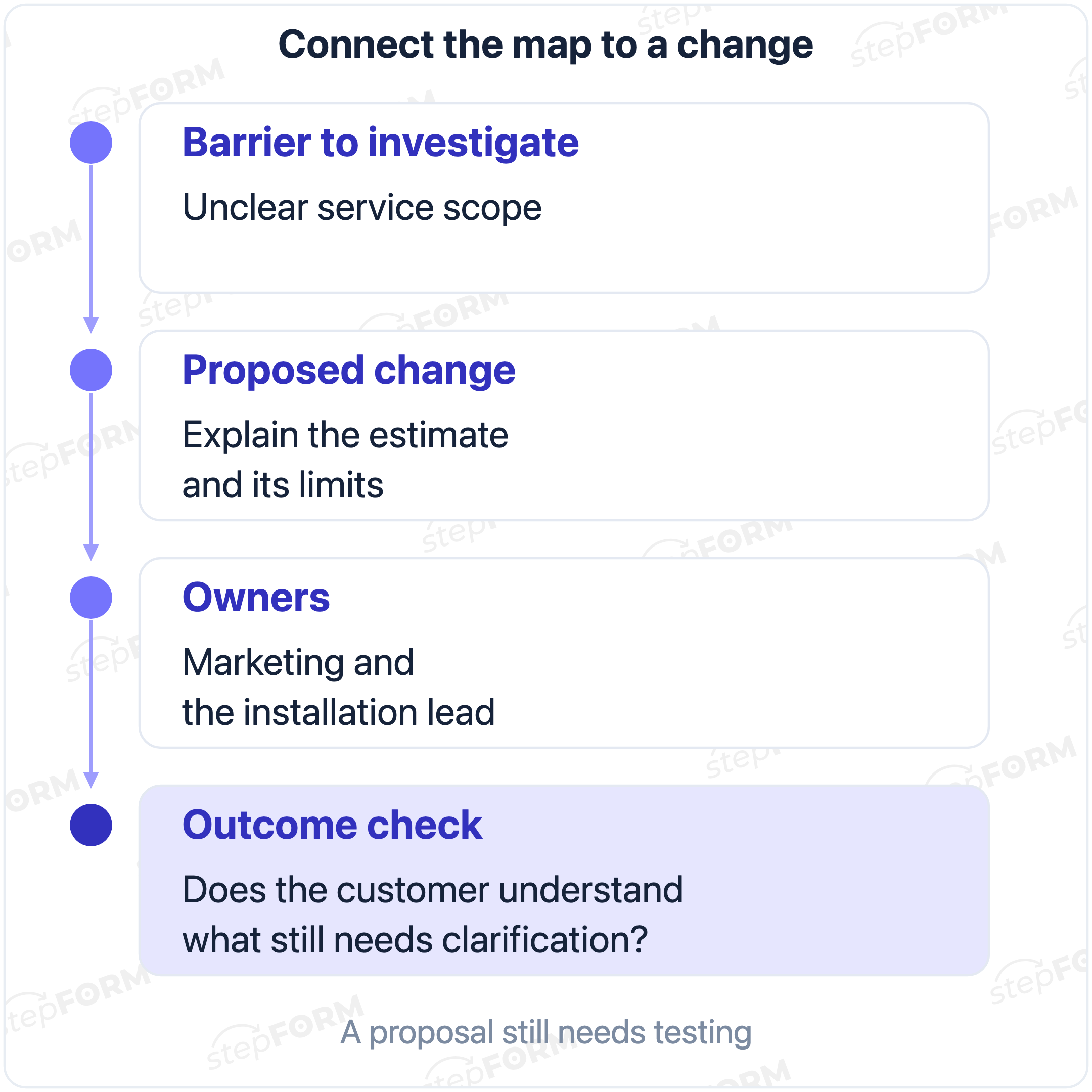
Choose an entry where you have grounds to investigate. Suppose your real records include questions about additional charges. Compare those inquiries with the ad promise and the service page. Extras described far from the headline price suggest one problem. Work that cannot be priced without an inspection presents another.
In the first case, the team could test a more visible explanation of the scope beside the estimate. In the second, it should explain the estimate's limits and offer a clarification request rather than present a provisional figure as a final quote. Confident wording cannot remove uncertainty in the service itself.
State the behavior you expect to change. For example: before sending a request, the customer understands that the figure is provisional and knows what needs clarification. Then decide how to check this. A manual walkthrough can test understanding. Later, you can examine inquiries about what the price includes. Fewer such questions would not, by itself, establish higher sales.
Assign responsibility for the change and for checking the outcome. They may belong to different people. Marketing can edit the page, while the installation lead checks whether its wording matches the work. Owning the map is not enough if that person cannot change the service terms.
A customer journey map template for your team
Copy these fields into a spreadsheet or shared document. Complete the context once per map, then repeat the stage entries as needed. Keep the current and proposed versions alongside each other.
| Field | What to record |
|---|---|
| Participant and task | Who follows the journey and what they want to accomplish |
| Boundaries | The starting event, end point, and excluded situations |
| State and date | Current experience or proposed change, plus the version date |
| Stage and touchpoint | The person's action, the channel, and the specific interaction with the business |
| Question and difficulty | What they need to learn or do; separate observations from assumptions |
| Evidence | Source, date, context, and anonymized excerpt, or a note that it needs checking |
| Proposed action | What to change and who owns it; leaving something unchanged is also an option |
| Outcome check | Expected behavior, measure, comparison conditions, and review date |
Unknown is a useful entry. It creates a research task. Do not automatically fill the gap with the opinion of the most confident person in the meeting. Where accounts conflict, keep both and check whether they describe different situations.
The working map does not need phone numbers, home addresses, or entire message histories: use anonymized excerpts and restrict access to the original material, leaving a situation description and a reference available to the responsible colleague for the discussion.
Adapt the template to another business
For a furniture order, the task could be fitting a wardrobe into an existing alcove. During comparison, the buyer needs to know who measures the space; before ordering, they need to understand how drawings are approved. If messages confirm confusion between provisional dimensions and the final measurement, the map gives you a specific task: explain which dimensions you need now and who checks them before production. This is another fictional situation, not a second researched case.
An online course follows a different sequence. A prospective participant checks whether the program suits their existing knowledge, then asks about scheduling and access. An employee paying personally and a manager arranging team training may follow different routes. Do not copy the installation stages into their maps.
The template preserves the questions you ask about experience, but its entries need fresh evidence. Reuse the fields, not the assumed fears and solutions. Even a similar question about price can hide different barriers: one person does not understand the service scope, while another needs a budget approved by the person deciding on the purchase.
Choose what to change first
Start with a barrier that obstructs the action you are examining and has evidence behind it. An error that prevents someone from sending a request calls for a different response from a guess about button color. The map makes that distinction visible. It does not assign priorities for you.
For each idea, discuss the consequences of the problem, the strength of the evidence, and the cost of checking it. You do not need to multiply subjective scores into an apparently precise ranking. Name the reason for your choice: the confirmation message says an appointment is agreed, although sales has not checked the schedule. Correct the promise and check understanding.
The conclusion may be inconvenient. The form might be fine. If the business promises a visit but cannot confirm the time, a new quiz will not produce available installers. The scheduling process needs attention. That leaves a process task on the map rather than a website design task.
Where stepFORM fits into the journey
Write a clear call to action for the next stepBuild the map in a table or diagram editor. Use stepFORM for specific interactions: ask questions, calculate a figure from rules you define, and collect a request. It does not automatically produce a CJM or establish why someone abandoned a purchase.
If your investigation finds that visitors struggle to understand the price scope, you can prepare a calculator in stepFORM. The author defines field values and the calculation formula, then explains which work is included and what still needs clarification. Plan a route for unknown parameters. A made-up default can produce a reassuring number that means the wrong thing.
Logic jumps let you change questions according to answers. Someone who says they need an old unit removed can receive the relevant questions. The form author defines and checks those branches. This example does not promise a ready-made air conditioner installation workflow.
Submitted inquiries appear in Responses, and the documentation describes CSV and XLSX exports. You can compare these answers with the manager's later clarification. They represent people who submitted the form. The export will not reveal the motives of visitors who left.
If someone is not ready to choose technical parameters and just needs to ask a question, a short inquiry form may be more appropriate. Decide what the customer needs to do before choosing the tool. A larger form does not automatically make the journey easier.
Check the change and update the map
Before editing, save the original description and define your measure. For the pricing question, you might track the share of inquiries where the basic work scope needed an extra explanation. Agree on the rule with sales: which inquiries qualify, where they record the label, and how they handle repeated messages.
Compare similar situations. A standard installation and a complex job with additional work require different amounts of clarification, and a change in advertising source, season, or order mix can affect the result alongside the page edit. Without accounting for these differences, you cannot attribute the whole change to the map.
Check understanding manually too. Ask someone to explain the figure they saw and what will happen after sending the request. If they believe a preliminary estimate is a final quote, the copy has not solved the problem, even if the form works perfectly. This checks comprehension. It is not statistical proof of a conversion increase.
Update the hypothesis after the check. Record what supported it, what contradicted it, and what remains unknown. Review the map when prices, channels, service terms, or new observations change the picture. A date in the corner is not a substitute for revisiting the contents.
Why journey maps end up unused
One route for everyone. A first-time buyer, a returning customer, and a partner arranging installation for someone else's home may have different tasks. Combine them carelessly and the map becomes too vague to guide a change.
Another trap is mapping only the convenient part. Even if you only track the website journey through submission, the customer's experience continues. A repeated question, an unconfirmed visit, or an unexpected price change can undo a clear landing page.
Then there is the map with no decisions attached. A difficulty without a next check or an owner will simply return at the next meeting. One entry the team can investigate is more useful than a large agreed poster that nobody acts on.
Found a point where customers need an estimate or a clarification request? Build that interaction in stepFORM and check it against your own scenario.
Open the calculator builderFrequently asked questions
Can I make a journey map without a website?
Yes. The map follows a person's experience, and interactions may happen in a store, on the phone, or through messages. Include a website only where the customer actually uses one.
Does each advertising channel need its own map?
Not necessarily. First check whether the task, expectations, and later actions differ. You can note a channel within one map. Separate scenarios when the channel leads to a substantially different experience.
How many interviews are enough for a journey map?
There is no universal number. It depends on the range of situations and the decision you need to make. A small set of conversations can identify hypotheses but cannot reliably estimate how widespread they are across all customers.
How can I use AI to build a journey map?
AI can help structure the table and suggest questions to investigate. Label its customer assumptions as hypotheses. Do not upload personal information or private correspondence without an approved process for handling that data.
What if customers give conflicting accounts?
Keep the differences and the context of each account. They may describe different services, expectations, or order conditions. Refine the scenario boundaries rather than average the conflict into one convenient story.