How to segment an audience around customer needs
Learn how to segment an audience by customer needs, check six cleaning service examples and use a worksheet to decide when to split or combine groups.
Guides  Daria Lisovenko
11 October 2026
Reading time ≈ 15 min.
Audience segmentation means grouping people by a difference that affects their needs or their response to an offer, starting with the task they want done and checking whether each group needs different service terms, evidence or a next step. If you would offer everyone the same thing, the labels may add work without helping a buyer choose.
Six segmentation examples · Copy the worksheet · Check your groups
A cleaning company could divide visitors into age groups, or distinguish someone who wants a weekly clean from someone handing back a rented apartment tomorrow. The second difference gives the team a decision to make about scope and timing. Age might still matter in some circumstances, but it does not explain these two requests on its own.
The cleaning business is fictional. Its six proposed segments are teaching examples, with no customer data or campaign results behind them, and demonstrate decisions you can check in your business. They do not establish that these groups are profitable or that using them will increase sales.
Segmentation comes before choosing a message
A target audience describes who a business intends to serve. A segment is a smaller group with a shared relevant characteristic. A persona describes a representative customer in more detail, but giving that person a name, age and favourite app does not prove that the group needs a separate offer.
What will you do differently for this group? A different photograph is a weak answer if the service, explanation and buying process stay unchanged. There may be a reason to adapt a message, but record what you expect that change to help the customer understand.
Segmentation also differs from lead scoring. A person who requests office cleaning has a different task from a homeowner, but that difference alone does not make one a better lead. Suitability depends on whether the company can fulfil the particular request, not on how impressive the segment name sounds.
Write a reason to choose an offer after you know who it is forChoose the criterion that changes a decision
OpenStax groups consumer segmentation into four types. Geographic segmentation uses location. Demographic segmentation uses characteristics such as age or household composition, while psychographic segmentation concerns values, preferences and ways of living. Behavioural segmentation looks at actions, purchase occasions or use of a service.
In B2B, firmographic criteria describe the organisation, such as its industry or size. A recurring office cleaning request might also depend on site access and who approves the contract, conditions you need to check rather than infer from a company headcount.
For the fictional cleaning service, geography could establish whether the address falls inside the service area. A stated preference about products might affect the proposed work. Booking history can distinguish an existing recurring customer from a first enquiry. None of these observations automatically reveals someone's budget or willingness to buy.
Start with the criterion closest to the decision you are trying to improve. If the problem is giving an accurate scope, ask about the work. Need to arrange access? Ask about access. Collecting age because a template includes an age field creates a column, not a reason to use it.
When to split a group, and when to combine it
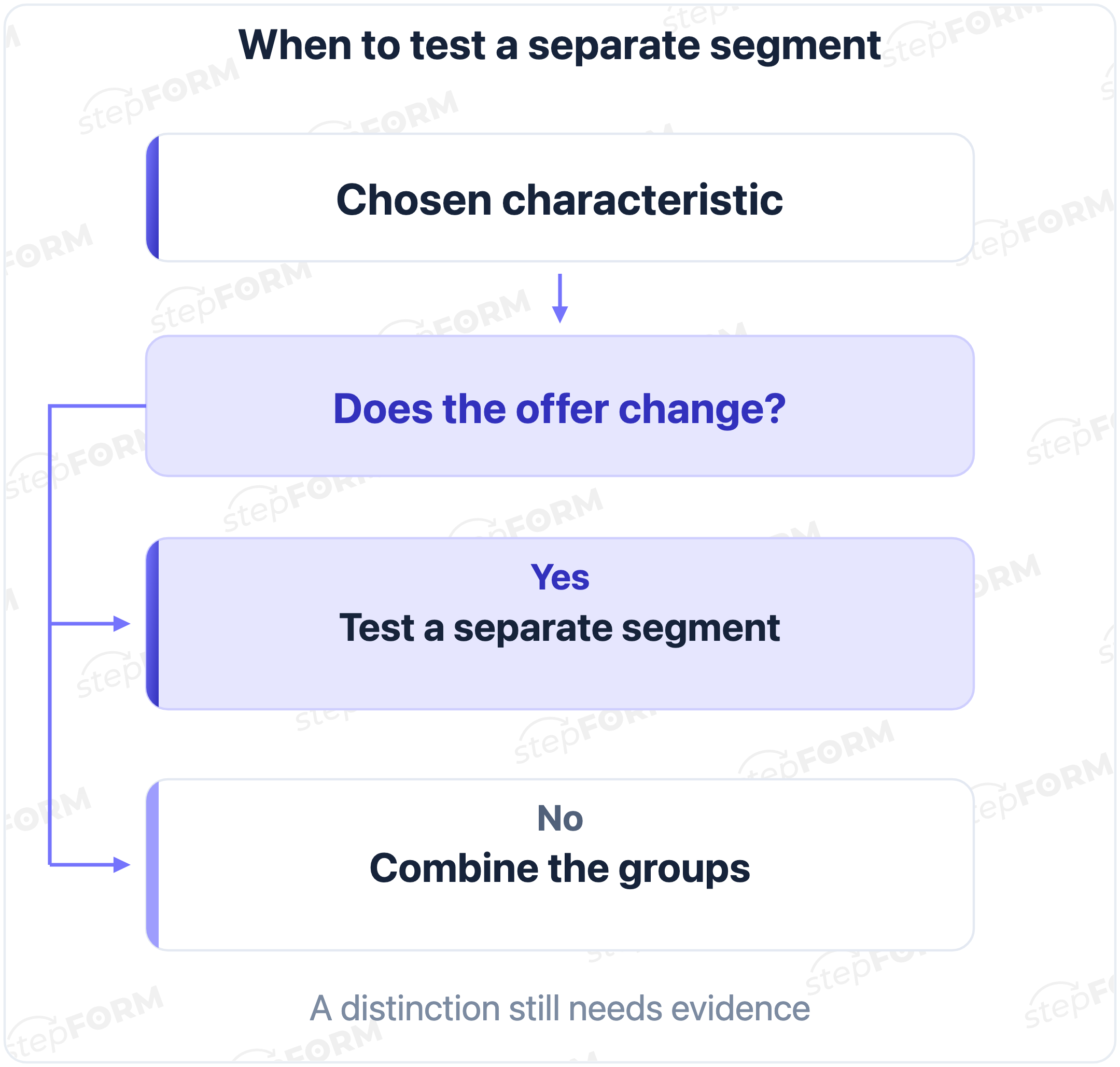
More groups do not guarantee better marketing. They can mean more upkeep. Each one needs a definition someone can apply, an offer the team can deliver and enough observations to review, so try combining labels that produce identical actions before building separate pages.
Use the five criteria in OpenStax's ADAMS framework as a short check: accessible, differentiable, actionable, measurable and substantial. In practical terms, ask whether you can reach the group, distinguish its needs, act on the difference, estimate its importance and justify the resources involved.
For example, "homeowners aged 30 to 39" and "homeowners aged 40 to 49" may need the same cleaning scope, checklist and booking process. Keep age as a separate attribute if you have a legitimate use for it, without maintaining two offers merely because a spreadsheet lets you draw the boundary.
Recurring home cleaning and cleaning after renovation could require different work and preparation, making a split worth testing if the team can explain that difference and fulfil both services. A new label cannot create equipment or capacity.
Combine groups when their needs and treatment prove alike, and split a group when requests inside it require conflicting terms. Retain a small specialist group only if the business has a reason to support it, bearing in mind that a strategically useful group can still be small and someone must account for the cost of serving it.
Also distinguish your whole market from the people who reach your form. Existing enquiries reveal the audience you currently attract, without telling you how many people never encountered the business or left before submitting a request.
Six audience segmentation examples for one cleaning service
These are six hypotheses about customer tasks, not six proven market segments. All service terms and documents mentioned here are illustrative. In a real company, check which ones exist and get permission before showing customer materials.
Recurring home cleaning
The task is maintaining a home on an agreed schedule. A request for repeated visits is a useful criterion here, with the proposed offer describing the standard room checklist, visit frequency and how access is arranged, rather than using age to define the service.
Show a sample recurring checklist and explain the rules for changing a visit. Agreeing the first visit and proposed schedule is the next step, subject to availability. Someone asking for a recurring service still needs to know what the regular clean excludes, so do not quietly add a deep clean to the promise because it makes the headline sound better.
A one-off deep clean
This customer wants a more thorough clean on one occasion, without necessarily planning future visits. Ask which areas need attention and about their present condition, since a one-off request by itself does not establish that every surface can be treated safely.
What extra work is included? Name it, along with exclusions. A sample scope is more useful than a promise to "clean everything." Before-and-after photographs can illustrate particular work if you have permission and explain the circumstances, though they do not guarantee an identical result in another home. The next step is a scope review before a quote is agreed.
Cleaning after renovation
The task concerns the condition left by building work. Use the fact that renovation has taken place as a starting criterion, with follow-up information about the residue and whether the work is finished. "Dust" does not identify a material.
The proposed offer separates agreed residue removal from work the team cannot handle. Show the inspection or scope checklist and explain limitations for surfaces and waste. The next step could be a review of photographs or a site assessment before confirming a quote. Only request photographs needed to assess the job, with instructions to avoid people and personal documents.
Move-out cleaning
The customer is preparing a property for handover. The relevant criterion is that handover task and its deadline, with any required checklist supplied by the customer, unlike a deep clean with no external inspection or key-return date.
The offer might cover agreed handover items and document the completed work. Show a sample completion checklist and state that landlord acceptance or return of a deposit is outside the cleaner's control. Check the handover requirements and available dates next: a deadline is a constraint to confirm, not a promise that the team can fit in any urgent booking.
Rental turnover cleaning
Here the task is preparing a rental between occupants, potentially across repeated changeovers. Agree how access, cleaning and checking readiness would work, including which responsibilities belong to the cleaning company and which belong to the host or property manager.
The proposed offer defines that turnover scope and the access arrangements, with a sample handover report showing what the owner would receive if this service is actually provided. Review the property and changeover schedule next. Guest arrival times remain constraints. Do not convert this example into a guarantee that every property will be ready between bookings.
Recurring office cleaning
The task is keeping a working site clean under a service agreement. The workplace request starts the classification, but the team needs details about access hours, relevant areas and the person approving the work before preparing a quote. "A business customer" is too broad.
The offer could define the agreed schedule and responsibilities for access and reporting. Show a sample specification that separates included work from specialist tasks. The next step is a site review and agreement on the scope with the responsible contact. A company name or larger budget cannot replace that check, and office work is not automatically the more valuable segment.
Keep one primary need and preserve the other details
A customer may need move-out cleaning after renovating an apartment. Both labels can be true. Ask which task determines the purchase now, then keep the other relevant facts as secondary tags or notes in your working classification.
The primary need helps organise an offer, while secondary information keeps the team from overlooking the deadline, renovation residue or access restriction. A customer's choice does not override safety limits or make unsuitable work acceptable. Staff still review the request.
For a report with non-overlapping groups, count each order once under its primary need and keep secondary details separately. If you count every need instead, one order can appear under several labels. Adding those counts will not give you the number of unique orders. Explain that distinction beside the totals.
Include an "Other" or "Not sure" route. Someone may not recognise your service labels or may have a request you did not anticipate, so keep their explanation and record that the primary need is unknown. Guessing a category will only make the report look complete.
Unknown needs and unknown acquisition sources are separate gaps, so record each as unknown until you have evidence. Neither means a bad lead. If someone later clarifies the task, update the classification while preserving the original answer and the reason for the change in your own records.
An eight-field audience segmentation worksheet
Copy these fields for each proposed segment. Keep observations separate from conclusions: "busy professionals" is a label to check, whereas "asked for evening access" records something someone actually said.
| Field | What to record |
|---|---|
| Customer task | The outcome the customer is trying to achieve now |
| Observed criterion | The answer or event used to assign the group |
| Source | Where the observation came from, or "unknown" |
| Evidence | What supports the proposed difference, and what remains assumed |
| Offer | The scope or terms that change for this group |
| Next step | What the customer is invited to do next |
| Owner | The person who reviews and updates the group |
| Check | The result or contradiction that would make you revise it |
Here is a filled teaching example. The task is preparing a rental between guest stays, with repeated changeovers reported in a form answer as the criterion and source. No orders are confirmed, so evidence is absent and the group remains a hypothesis. The proposed offer is an agreed process for access, cleaning and checking readiness. Next, discuss the schedule and first property. Assign the employee who checks whether the company can provide this service. To review the group, ask whether the process differs from an ordinary one-off clean and whether repeat orders justify the separate work.
Try a counterexample: someone only says, "The apartment needs cleaning." You cannot assign that request to rental turnover because there is no evidence of repeated guest stays. Ask about the task before sending an offer intended for rental owners.
You can test this worksheet without software. Give a colleague the rule and some anonymised enquiries, then ask which ones meet the criterion, which do not and which need clarification. Disagreement shows where the wording needs work. It does not establish that the group is commercially useful.
Now test a contradiction: "I am moving out after renovation." Ask which outcome determines the purchase. If handover is primary, retain move-out as the main need and renovation as a secondary detail, reversing them if removing renovation residue is primary. Review the combined scope either way. A rule that accepts only one answer and discards the other has failed this test.
Check the groups before changing all your marketing
Begin with requests you can inspect legitimately: enquiries, approved order notes and conversations about real purchases. Record the customer's wording so that a colleague's assumption about wanting the cheapest service is distinguishable from a customer explicitly stating a spending limit.
Website behaviour can help identify a question to investigate. A visit to a move-out page could concern a handover, comparison shopping or another reason. As Nielsen Norman Group explains about analytics, behavioural records alone do not supply the full explanation for people's actions. Ask about the task instead of treating the page view as proof of motivation.
Review completed jobs alongside enquiries. Does the proposed difference survive when the work is agreed? Track reclassification and why it happened, keeping duplicates, staff tests and missing answers identifiable so they do not quietly become evidence of demand.
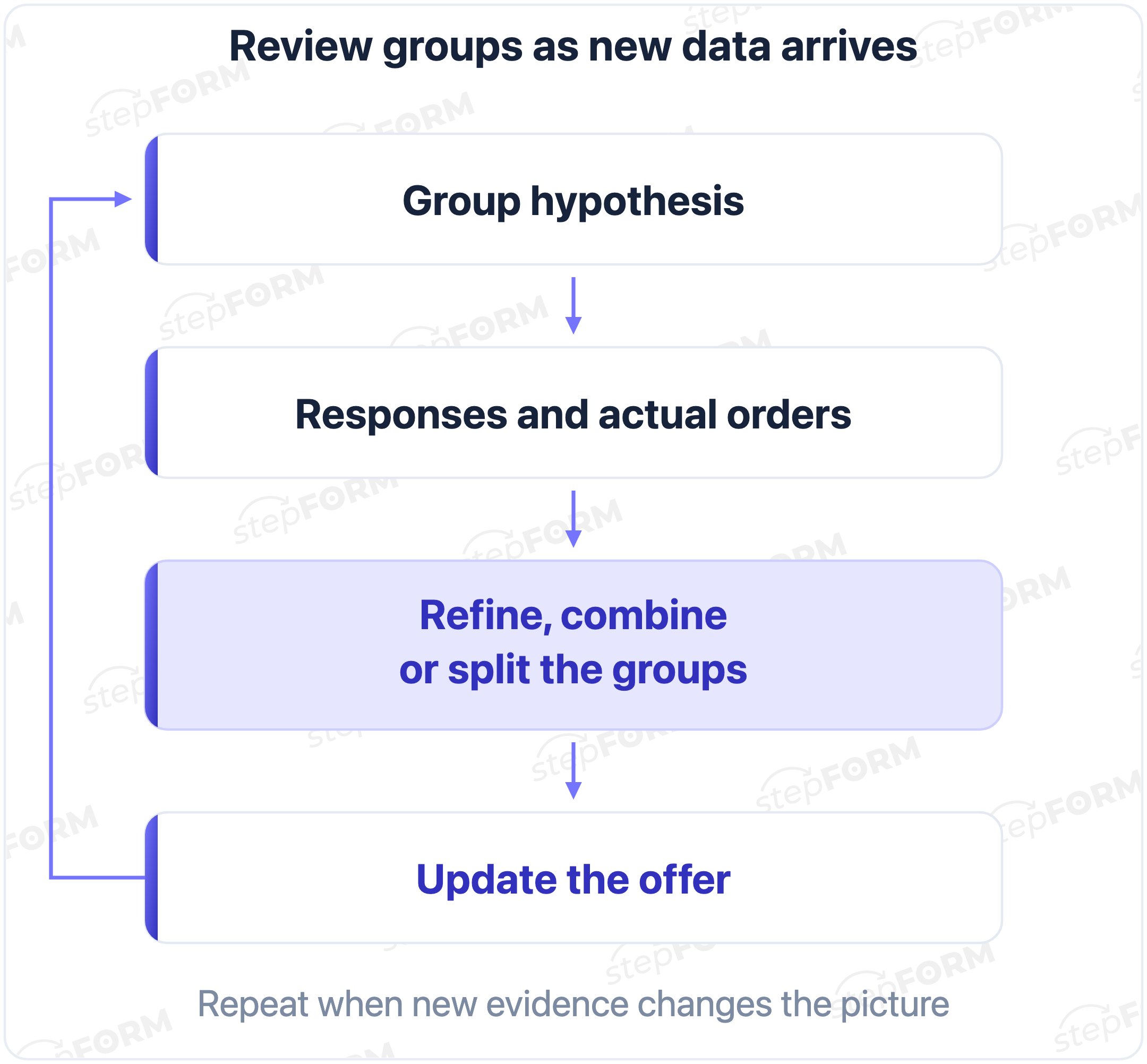
Test one proposed offer for one task before replacing every campaign and page. Choose the outcome you want to examine in advance, such as enquiries the team can accept for that service. Keep the audience source and conditions comparable, using random assignment where practical to help separate the offer's effect from changes in who sees it.
Changing the traffic source and the offer together leaves you unable to attribute a different result to segmentation alone. A few successful orders can support further investigation, but small samples do not establish a winner or a guaranteed improvement. The observations needed depend on the baseline and the difference you are trying to detect.
Decide when to review the test and who will act on it. Two groups keep needing the same work? Combine them. Requests within one group conflict? Investigate a split. If the team cannot fulfil the proposed terms, revise the offer regardless of the number of clicks.
Follow an enquiry through to the outcome that matters to the businessCollect the relevant answers in stepFORM
In stepFORM, you can ask about the customer's task and configure conditions to show or hide relevant questions. The logic jump documentation describes these rules. You would decide which follow-up questions belong to a move-out or office request in our illustrative service and configure those conditions yourself. The form does not research the market or discover customer groups automatically.
The Responses documentation describes reviewing answers and exporting them in CSV or XLSX for your own analysis. Compare those answers with confirmed orders outside the form, using your worksheet. Keeping an answer is not proof of a stable segment, and this workflow does not include automatic clustering or follow-up email campaigns. Start with one useful question and build a quiz in stepFORM. Check its answer paths, including "Other," before using it for real enquiries.
Choose the fields needed to continue a particular requestFrequently asked questions
Can I segment an audience before I have customers?
You can propose groups from conversations, public information and the service you intend to provide. Mark them as hypotheses and record the source of each assumption. Without customer or order evidence, avoid presenting their size, profitability or response as established facts.
Do I need a separate landing page for every segment?
No. First check whether the offer differs and the team can deliver it. A shared page with clearly explained service choices may be enough. Give a separate page a distinct task and conditions to explain, with someone able to keep those details current.
Do I need AI for audience segmentation?
No. You can develop initial hypotheses from enquiries, orders and a working table. Automated analysis of a large dataset still requires checks on data quality and what the resulting groups mean. A cluster name does not establish a customer's need.
How can I segment a new product's audience without copying competitors?
Look at other offers for questions and alternatives to investigate with your potential customers. A competitor's groups depend on its product, channels and capabilities. Copying those labels does not establish that your business can serve the same needs.
Should I delete old segments when the rules change?
Keep the previous definition and the date of the change. Classify new orders under the current rules and account for different definitions when comparing periods. Otherwise, a change in classification can look like a change in demand.