How to write a business proposal a client can compare
Write a business proposal with a clear scope, itemized price and next step. A worked service example and an eight-field template you can copy.
Guides  Daria Lisovenko
22 October 2026
Reading time ≈ 16 min.

A business proposal explains what you will supply to a prospective client, what it costs, and what needs to happen next, so the reader can compare the proposed work with their needs. For a service, name the deliverables and explain the price. Make the limits visible before anyone agrees to the job.
“Product photography from RUB 30,000” leaves room for very different interpretations. How many products? How many finished images? Who handles delivery? A proposal turns those questions into a defined offer. It also gives the buyer somewhere to point when they ask for a change.
This guide follows a fictional photography project for a small online catalog. All prices are invented for the example and remain in RUB throughout. They are not market rates, a currency comparison, or a reported stepFORM customer result. The template is included in the article for you to copy.
Choose the decision the proposal should support
A new prospect may need to decide whether your service is relevant enough for a conversation, while someone who has already shared a brief needs to judge whether the proposed scope, price, and schedule fit the project. The same document can leave one of them working through information they cannot use yet.
Here we focus on a client-facing sales proposal, rather than a business plan for investors. HubSpot's proposal guide also separates a client proposal from a business plan and puts the buyer's needs, proposed solution, qualifications, and pricing in the document. The worked example below applies that distinction to a small service purchase.
“We understand online retail” says little about the images the buyer will receive, even if you have good reasons to claim it and relevant work to show. Your reason to be chosen belongs in the proposal. It cannot stand in for the scope.
How to explain why a customer should choose youCollect the facts before you write
Start with the buyer's task. In our example, a catalog manager needs consistent images of twelve products for an online listing. Record the intended use, required format, and approved shot list. If a detail could change the amount of work, settle it or mark it as an assumption.
Ask what would make the delivery unusable. A buyer who needs one image format may reject another even when the photographs look good, just as two angles of the same product do not meet a requirement for a different background. Settle those details while a correction still costs a conversation.
Check who can approve the work. The person requesting a price may need a colleague to sign off on the shot list or payment, so establish whose decision starts production and where feedback should come from. There is no need to collect the company's entire reporting structure.
Keep unresolved points visible. If the client has not confirmed whether they need models, explain what the quoted version covers and what you still need to price, rather than quietly assuming models are included. A specific gap is easier to resolve than a confident but unsupported total.
An eight-field business proposal template
Copy these fields into your document and replace the brackets. The right-hand column is a writing prompt, not text to send unchanged. Expand a field when the project needs it. A short assignment does not need a long company biography to look legitimate.
| Field | What to put there |
|---|---|
| 1. Recipient, date, version | To [client]. Prepared [date]. Version [number]. Name the project so the buyer can identify the correct offer. |
| 2. Buyer task | You need [result] for [use]. We based this proposal on [brief or agreed inputs]. |
| 3. Deliverables and limits | We will deliver [quantity and format]. Approval follows [specified criteria]. Corrections include [defined allowance]. |
| 4. Included and excluded scope | The work includes [items]. It excludes [items]. Changes to [assumptions] require a revised proposal. |
| 5. Price and optional scope | [Item]: [quantity] × [unit price] = [line amount]. Base total [amount]. Optional addition [amount]. State tax treatment and the complete amount payable. |
| 6. Timing and dependencies | Work takes [period] after [starting conditions]. Explain how client review or missing inputs affect the schedule. |
| 7. Payment, validity, availability | Payment follows [agreed terms]. Prices are reviewed after [period]. Confirm availability separately. |
| 8. Proof, contact, next step | See [relevant evidence]. Contact [person and channel]. Please [specific action] so we can [next step]. |
You can use these fields in an email or a longer document. The layout can change. The buyer should still be able to find the total and its conditions without searching through a sales presentation just to discover what the offer includes.
A complete service proposal example
The following is an educational proposal for product photography. It contains a base scope and one optional addition. The studio, project, and prices are fictional. In an actual proposal, replace the recipient and date placeholders, add genuine evidence, and confirm the tax treatment before giving the buyer a complete payable total.
Project and expected delivery
To: [Catalog manager and company]. Date: [Proposal date]. Version: [Current version].
Task: prepare consistent product photographs for a small online catalog. The base scope covers twelve products and two finished photographs per product, for twenty-four finished photographs in total.
Delivery consists of JPEG files at 2,000 pixels on the long edge, following the approved shot list and using a plain white background. Agree the shot list before production so both parties know which views of each product are required.
Base price
| Item | Calculation | Amount |
|---|---|---|
| Preparation | Flat amount | RUB 6,000 |
| Photography | 12 products × RUB 1,200 | RUB 14,400 |
| Retouching | 24 finished photos × RUB 400 | RUB 9,600 |
| Base total | 6,000 + 14,400 + 9,600 | RUB 30,000 |
The units are different on purpose: photography is priced per product, while retouching is priced per finished photograph, so the buyer needs both units beside the rates to check what the total covers.
Optional addition
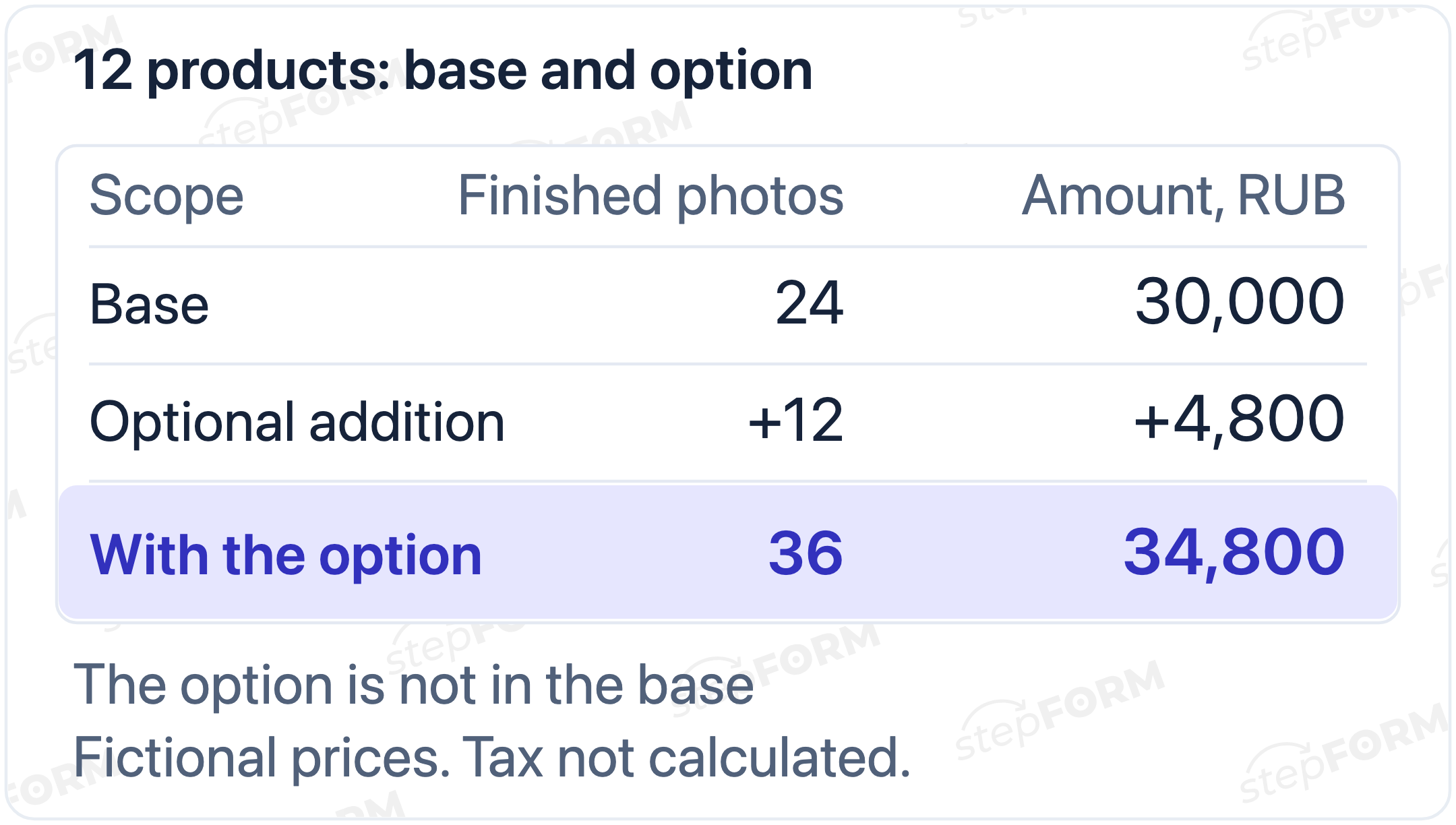
The expanded scope adds twelve finished photographs at RUB 400 each, for an additional RUB 4,800. This teaching price assumes the extra images come from the same photography session. That makes thirty-six finished photographs and an expanded total of RUB 34,800. Present this addition as optional, rather than including it silently in the base offer.
Schedule and corrections
Production takes six working days after all products arrive, the shot list is approved, and the agreed advance is received, excluding delays while waiting for the client's approval.
One consolidated round of color and crop corrections is included. A changed shot list or a reshoot is quoted separately. “Consolidated” means the client gathers the requested corrections into one round, rather than sending a new instruction whenever someone else reviews the files.
Exclusions and commercial conditions
The quoted scope excludes delivery of products to and from the studio, models and props, complex compositing, and a reshoot after a changed brief.
In this fictional example, the client pays 50% after agreeing the scope and the remaining 50% before receiving the finished files. Each payment is RUB 15,000 for the base scope or RUB 17,400 for the expanded scope. These are teaching-case terms, not a payment rule for every business. Tax is not calculated here. A real seller must state the applicable tax treatment and the full amount the buyer will pay.
The price review window is ten calendar days from the proposal date, with availability confirmed separately. It does not reserve a production slot.
Next step
Please reply with the base or expanded scope and approve the shot list. The studio will then confirm an available date and agree the paperwork. A request for a quote is not acceptance or a booking.
Make prices comparable without hiding the differences
Suppose another supplier sends the buyer a cheaper total, which may cover fewer finished photographs, a different revision allowance, or delivery without the same output requirements. The buyer needs to see those differences before choosing.
Start by comparing the same job. Check the product count, finished image count, format, background, and correction allowance. Keep exclusions beside the scope they qualify. If you move them into distant small print, the headline amount becomes easier to misunderstand.
The expanded version provides additional finished images. That is a choice the buyer can assess, unlike a second package that merely repeats the first with a more flattering name and leaves the difference for the client to guess. Explain what changes and what stays the same, including any conditions that need separate confirmation.
A discount also needs a defined starting point. Reducing the amount while leaving the work ambiguous does not resolve the buyer's problem. If the budget cannot cover the proposed scope, discuss a smaller deliverable before rewriting the price.
Write timing and limitations where they matter
“Ready in six days” looks simple until the products arrive late or nobody approves the shot list. Tie the production period to the conditions that start it. Our example requires all products to arrive, approval of the shot list, and receipt of the agreed advance. Missing one condition means the stated production period has not started.
Explain what happens when the request changes. Correcting the crop of an agreed image and photographing a different view are different jobs. The proposal should distinguish them before either party treats an allowance as unlimited work.
A ten-day price review window says when the quoted prices need another check, without promising that a particular date will remain open for the same ten days. Confirm the date separately. An expiry line should not imply a reservation.
These are writing examples, not a universal contract or tax rule. When the legal effect of an offer, an acceptance process, or a payment clause matters, have the wording checked for the actual transaction and jurisdiction.
Make the promised delivery checkable
Read the example's delivery description as a review checklist. Count the final files against the approved shot list, including the two agreed views for each of twelve products. Twenty-four files in a folder would not resolve a missing view of one product if another appeared more often.
Check the format and dimensions. The base scope calls for JPEG files at 2,000 pixels on the long edge, with the agreed views on a plain white background. A visually pleasing picture can still miss one of those requirements. Name the discrepancy when discussing delivery so the conversation stays tied to the agreed work.
Gather color and crop comments into the one consolidated correction round. Keep a request to change the shot list or arrange a reshoot separate, since those sit outside the correction allowance in this example. The distinction is easier to discuss when the original proposal states it clearly.
Adapt the proposal to products or a monthly service
For a product sale, keep the same eight fields but change the units. Identify the item, specification, quantity, and delivery requirements. Separate the goods from optional services, then make the complete payable amount and its tax treatment clear. A product name alone may not distinguish the configuration the buyer expects.
For a monthly service, describe the period and included workload. Specify which deliverables belong to that period, how feedback is handled, and what counts as extra work. State what happens to a request that falls outside the agreement instead of suggesting that a fixed fee buys unlimited availability.
Take a monthly catalog-support service, without adding another invented price. Does the fee cover preparing new images, updating existing assets, or both? Identify who provides the inputs and approves delivery, because a promise to “support the catalog” leaves those decisions for a later argument.
Do not copy the photography example's timing or advance into another business by habit. Those are assumptions of this teaching case. Reuse the questions, then fill the fields with terms your business can actually fulfill.
Replace vague promises with checkable wording
Vague: “We provide high-quality photography with fast delivery.” That asks the client to supply their own meaning for both quality and speed.
Specific: “The base scope delivers twenty-four JPEG photographs, two per product, at 2,000 pixels on the long edge and on a plain white background. Production takes six working days after all products arrive, the shot list is approved, and the agreed advance is received.” The buyer can check those conditions against the assignment.
Vague: “Any changes can be discussed.” This does not tell the buyer which work the quoted amount covers.
Specific: “One consolidated round of color and crop corrections is included. Changes to the shot list or a reshoot are quoted separately.” The revised wording keeps room for discussion while defining the existing offer.
Keep claims about experience just as concrete. Link to genuine work relevant to the assignment and explain why it is relevant. Do not invent a client quote or a performance percentage to make a small proposal look more established.
For the photography assignment, a buyer could compare your real portfolio with the requested background, angles, and image use. Identify your own contribution to that work. This article's invented project is a teaching example, not portfolio evidence. Attractive images alone are no basis for promising the client more sales.
Send the proposal with one clear request
A document can be complete and still arrive without useful context. In the accompanying message, identify the project, attach or link the current version, and ask for the decision it supports. For our example: choose the base or expanded scope and confirm the shot list.
Check the recipient, filename, date, and figures together before sending, since an old version with a new email can leave the buyer comparing different scopes without noticing. If you revise the offer, say what changed and identify the version that replaces the previous one.
Leave a route for unresolved questions. A buyer might want the expanded image count but need to clarify product delivery. The next step should allow that question rather than force a misleading yes or no.
When you follow up, ask about the actual decision. Is the scope suitable, does an exclusion need discussion, or is the project waiting on an internal approval? Silence alone does not tell you that the price is wrong. If the buyer gives a reason, record it in their words before changing the proposal.
Choosing a call to action for the next decisionUse stepFORM to collect the inputs for a proposal
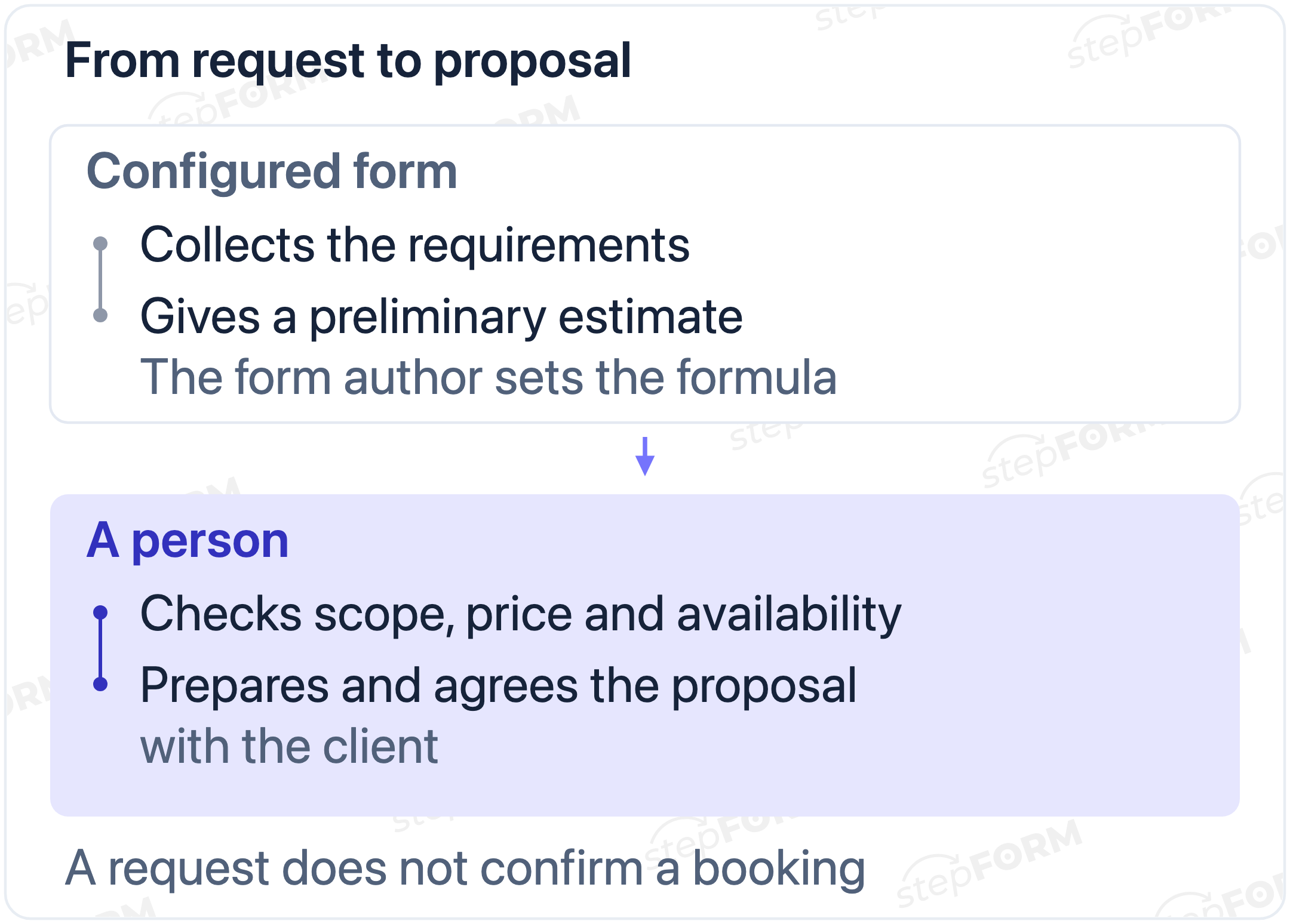
A proposal starts with usable answers. In stepFORM, the author configures the questions and logic jumps so a prospective client sees the questions relevant to their request. For a photography inquiry, that might mean asking about product count, required views, and the intended use of the images.
You can configure a formula for a preliminary estimate where the rules are known. Explain what that estimate includes and which inputs still require a person's review. A number on a result screen does not establish that the client and supplier have agreed the scope.
You can review submitted answers in the Responses section and export them as CSV or XLSX. A person then checks the requirements and prepares or agrees the final proposal, paying attention to ambiguous inputs, unusual products, and conditions outside the standard calculation.
This workflow does not assume an automatic PDF proposal generator, tracking of whether a quote was opened, or automatic booking. The form gathers the request. The seller remains responsible for the final offer and its terms.
If your pricing already lives in a spreadsheet, use the Excel pricing guide to plan the calculation separately. The proposal still needs a defined deliverable and conditions, even when the arithmetic can be reproduced.
Collect the client's requirements before preparing the final offer.
Build a form for proposal requestsA final check before the buyer sees it
Read the proposal as someone comparing suppliers. Can you identify the result, quantity, amount, starting conditions, and next action without asking the author? After a scope change, check the arithmetic again: a corrected total with an unchanged advance is still an inconsistent offer.
- Every price has a unit or a clearly named flat scope.
- Optional work is separate from the base total.
- The schedule has explicit starting conditions.
- Corrections and exclusions describe actual boundaries.
- The recipient can see which version to respond to.
- Claims and examples are supported by real evidence or clearly marked as fictional.
For the teaching example, the base advance stays RUB 15,000 and the expanded advance is RUB 17,400. Both follow the same 50% rule. That small check is worth doing before a polished file leaves your inbox.
Frequently asked questions
How long should a business proposal be?
Use enough space to define the decision, scope, price, and conditions. A simple assignment may fit in a short email. A complex purchase may need supporting detail. Length alone does not tell the buyer whether the offer covers their requirements.
Should I send a proposal before I know the client's budget?
You can send a defined starting scope or a preliminary estimate, but label assumptions and unresolved details. If a missing answer could change the work or amount, explain that dependency. Do not present an unverified estimate as the final agreed price.
Can AI write a proposal for me?
AI can help organize supplied facts or suggest clearer wording. A person must check the scope, figures, conditions, and claims before sending. Do not let generated examples become supposed client evidence or upload confidential material without an approved process.
Does a quote request reserve a date?
Not in the workflow shown here. A quote request collects requirements. The seller then confirms availability and agrees the paperwork. State the actual acceptance and booking process for your business rather than letting the form imply a reservation.
Can I use this template for a monthly service?
Yes. Define the service period, included workload, deliverables, feedback process, and boundaries for extra work. Replace the photography case's timing and payment assumptions with terms suited to your service. Keep the next decision clear.