The Awareness Ladder: Match Your Message to What Buyers Know
Use Ben Hunt's Awareness Ladder to match your message to what buyers know. Six levels, a worked IT support example and a template for planning content.
Guides  Daria Lisovenko
5 November 2026
Reading time ≈ 12 min.

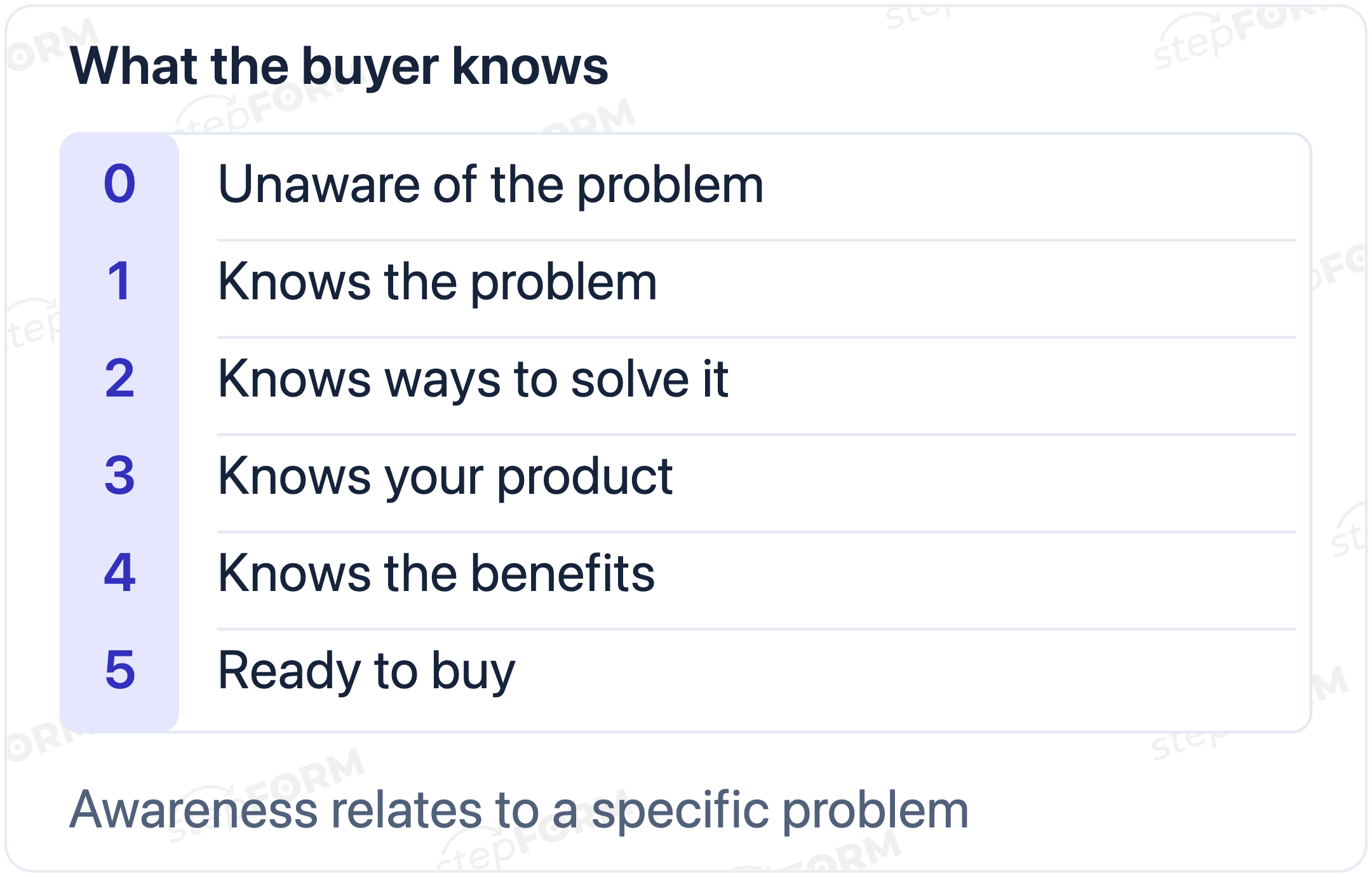
The Awareness Ladder is Ben Hunt's framework for choosing a marketing message based on what a prospective buyer knows about a problem, possible solutions and your offer. It has six levels, numbered 0 to 5. Use it to identify the missing explanation or evidence before asking someone to take the next step.
A visitor trying to understand a recurring problem needs different information from a buyer checking the terms of a service they already want, even when both arrive on the same page. Ask what each person still needs to understand before making a decision.
The fictional office IT support service in this guide gives us a way to hold the business, offer and audience constant while changing the information each buyer needs. The examples and planning template are teaching materials. They do not report customer results or proven conversion improvements.
What the six levels mean
Hunt describes the model in Convert!, published in 2011, and revisits it in his introduction to the Awareness Ladder. The six-level account below follows the book-based explanation that Hunt links from that introduction.
- 0. Unaware of the problem or opportunity. The person has not recognized a need to change.
- 1. Aware of the problem. They recognize the problem but do not yet know of solutions.
- 2. Aware of possible solutions. They know ways to address the problem, but not your particular solution.
- 3. Aware of your solution. They know it exists but have not understood its benefits for them.
- 4. Aware of the benefits. They understand the benefits but are not yet convinced or ready to buy.
- 5. Convinced and ready to buy. They have decided they want the offer. The purchase may still be ahead.
Keep those numbers if you use this template. A five-stage customer awareness model attributed to Eugene Schwartz is a separate classification. Mixing its labels with Hunt's numbering makes the meaning of a stage unclear.
For practical work, treat the ladder as a way to organize questions. It cannot tell you how many visits someone needs, how quickly they will decide or whether they can afford the purchase. A customer can understand an offer perfectly and still reject it.
Two buyers, one page, different information gaps
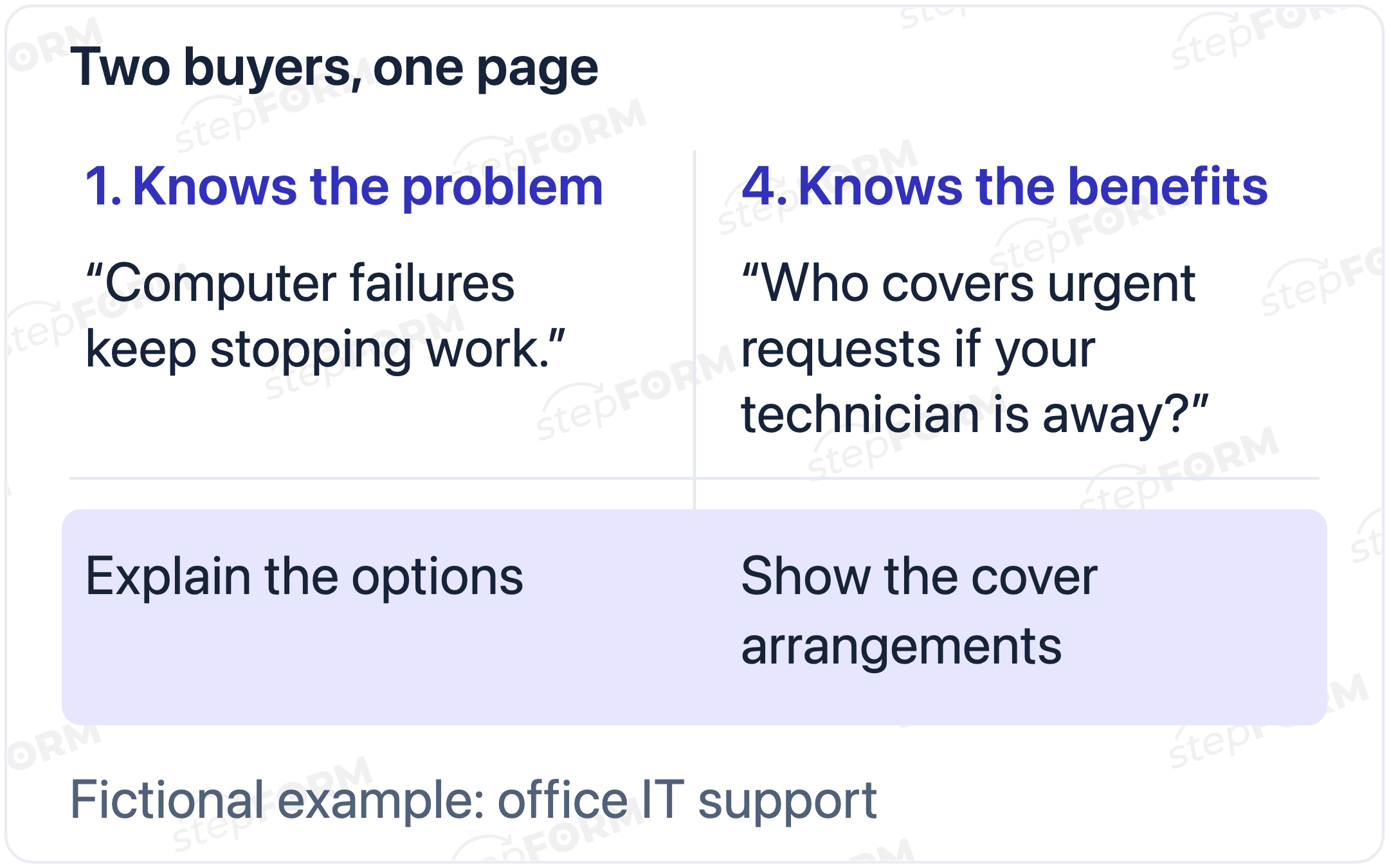
Imagine two office managers from similarly sized businesses opening the same page for a provider's monthly computer support service. They fit the same broad audience description. Their questions differ.
The first says: “Work keeps stopping when office computers fail.” They have noticed the interruption but have not explored support options, which suggests level 1 without establishing that they need a monthly contract. They may need to compare occasional repairs, internal responsibility and an outside support service before deciding what suits the office.
The second has read the package details and understands the benefit of having someone responsible for support, but asks: “Who handles urgent requests when our assigned technician is unavailable?” This fits a level 4 discussion. They need to examine the provider's actual cover arrangements before agreeing.
For the first visitor, explain the available ways to organize support, where each fits and what each leaves the office to handle, so they can compare the arrangements before considering a contract. A sales pitch may be premature.
The second visitor needs evidence. Show the real process for handling an absent technician, including its limits, if the business has one. Relevant terms or a clear answer from the service team can resolve this question. Another paragraph about how reliable support saves time would leave the concern unanswered.
The product and type of customer have stayed the same. The information gap gives the marketer a specific reason to change the message.
An awareness planning template you can copy
For each real customer question, record the signal, your provisional level, the unanswered question, the message, its supporting evidence and a suitable next step. All signals below belong to the fictional IT support example.
| Observed signal and interpretation | Message, evidence and next step |
|---|---|
| 0. No recognized problem. “Someone in the office usually fixes it.” Possible gap: the manager has not examined the disruption. The phrase alone does not establish this. | Invite the reader to note what interrupts work and who deals with it. Use a simple incident log, without inventing a cost of downtime. Next step: check whether there is a recurring problem worth addressing. |
| 1. Problem recognized. “Work keeps stopping when office computers fail.” Question: what could we do differently? | Explain occasional repairs, an internal owner and an outside support arrangement. Give honest limits for each. Next step: identify which kind of help the office needs. |
| 2. Options known, your service unfamiliar. “We are comparing an in-house technician with an external support service.” Question: which approach fits our office? | Explain the differences in responsibilities, availability and covered work, then introduce your service with its actual terms. Next step: inspect the option that matches the requirements. |
| 3. Your service known, relevance unclear. “What would your monthly plan change for our office?” Question: how does the included work help us? | Connect each relevant service task to the buyer's stated problem. Show an example request handled under the actual scope. Next step: check the proposed scope against the office's needs. |
| 4. Benefits understood, a concern unresolved. “Who handles urgent requests when our assigned technician is unavailable?” Question: can we rely on this arrangement? | Explain the real cover process and its limits. Support it with current terms or a verified service-team answer. Next step: clarify the unresolved condition before agreeing. |
| 5. Ready to buy. “The scope and terms work for us. How do we start?” Question: what must happen to begin? | State the agreed scope, payable amount, start conditions and acceptance process. Next step: complete the actual agreement process. An inquiry alone does not activate the service. |
Add the source and date beside each signal. A question from yesterday's sales call and a sentence the team invented in a workshop can both help plan content, but only one records what a customer actually asked. Keep that distinction visible in the notes.
Leave a field blank if you lack the evidence. For example, a copywriter should not promise backup technicians because a level 4 prospect would find that reassuring. The service team must confirm what actually happens. If there is no cover arrangement, the answer needs to say so.
Find the customer's question before assigning a level
Start with material customers have already provided: inquiry forms, sales conversations and questions sent before a purchase. Keep their wording where permission and your internal process allow it. Then note which information would help answer the question.
A search phrase can suggest a starting point. “Ways to handle office computer problems” and “monthly support contract terms” imply different immediate interests, though neither tells you everything the searcher knows. A competitor may be researching your offer, or an existing customer may be finding a document for a colleague.
The page visited is weaker evidence still. Someone who opens pricing might be ready to buy, gathering a budget estimate or ruling out an expensive option. Record the action as an action. Do not silently turn “viewed pricing” into “convinced.”
When you can ask a question, ask about the current task: “What would you like help with today?” Offer plain options such as understanding support choices, checking a particular package or discussing a start date, with “I'm not sure” or space to explain for people who do not fit those options. Visitors should not have to understand your marketing model to answer.
An answer helps you choose what to show next. It remains a clue. If the follow-up conversation reveals a different need, revise the interpretation instead of defending the original label.
Keep awareness separate from audience, journey and CTA
Audience segmentation groups people using differences that affect your business decisions. Awareness adds a question within a group: what does this person know about this problem and offer? Two office managers can belong to the same segment while needing different explanations.
A customer journey map records actions and touchpoints over a defined experience. You can annotate a touchpoint with an awareness hypothesis, but the ladder is not a record of the route someone took. A buyer may arrive with knowledge gained elsewhere.
The call to action names the next action. Choose it after deciding what information the visitor needs. Rewriting “Contact us” as “Find my solution” will not explain a missing service condition. The message and proof have work to do before the button.
Choose one information gap to test
Take a page where you can identify a recurring question. Write a short hypothesis: “People who understand the monthly plan still ask who covers absent technicians. A clear explanation of that process may help them judge whether the arrangement fits.” This names the audience, missing information and proposed change.
Check that the explanation is true before testing it. Then compare how prospective buyers use it. Do they still ask the same unresolved question? Can the sales team see which conditions need discussion? Are the inquiries relevant to the service described?
Pick the outcome before looking at results. For an explanatory article, you might track visits to a relevant comparison. For a service page, completed inquiries and the proportion the team can actually help may be more useful. A click is not proof that someone moved up a level.
If you change the traffic source, offer and page at the same time, any difference has several possible explanations. Keep those conditions visible in the record. A controlled test can help isolate a message change when you have enough appropriate traffic; a small set of conversations can uncover a misunderstanding without establishing a conversion lift.
You may discover the message is fine and the offer does not fit. The technician cover question, for example, could reveal a requirement the supplier cannot meet. More persuasive wording would not close that service gap.
Use a form to ask what help the visitor needs
In stepFORM, the form author can configure logic jumps based on answers to determine which questions or elements a visitor sees next. You set the conditions, including the fallback when no condition matches.
For the IT support example, you could start with “What would you like to clarify?” Someone exploring support options could receive a question about the recurring problem. Someone checking your package could describe an unresolved condition. A person ready to discuss starting could provide the requirements needed for that conversation. Keep an option for people who are unsure.
You decide the wording, paths and response process for this proposed form design. It does not assess awareness automatically. Show the visitor relevant information without attaching a psychological score to their answer.
Submitted answers appear in Responses, where they can be reviewed or exported as CSV or XLSX. Review the questions people actually submit and compare them with your assumptions. These records describe submitted responses, not everyone who visited or left the form.
Turn one unanswered customer question into a short form with relevant follow-up questions.
Build a branching form in stepFORMFrequently asked questions
Should I create a separate page for every level?
No. Start with distinct questions and the evidence needed to answer them. One page can serve several questions if people can find the relevant information. Separate pages make sense when the topics need different explanations, entry points or depth, not just because the model has six levels.
Can an existing customer be at a low awareness level?
Yes, for a different problem or offer. Someone may know your company well and still be unfamiliar with a new service or unaware of a need it addresses. Define the topic before assigning a level. Customer status alone does not tell you what the person knows.
What if several people make the purchase decision?
Record their questions separately. The person who will use the service may understand the benefit while the person approving the expense needs the scope and terms. Sending both the same material can leave one person's question unresolved. The relevant level belongs to a person and topic, not automatically to the whole company.
Does a ready buyer need more educational content?
They may need a clear way to complete the purchase and check its conditions. Keep supporting information available, but do not make them work through an introductory sequence before they can proceed. Readiness still does not establish payment, acceptance or availability.
How often should we update the awareness template?
Review it when customer questions, your offer or its conditions change. Keep a date and a source for each working assumption. If new inquiries repeatedly contradict a row, revise it rather than waiting for an arbitrary review date. An untested row should remain labeled as a hypothesis.