
How to Create a Customer Feedback Form
Build a customer feedback form step by step: which fields to use, which rating scale, what to ask and what platform rules forbid. With data from 65,863 ratings.
How-to  Daria Lisovenko
11 September 2020
Reading time ≈ 11 min.
Daria Lisovenko
11 September 2020
Reading time ≈ 11 min.

A feedback form is one of the easiest things to build and one of the hardest things to make work. The build takes ten minutes: a rating, a question, a submit button. Getting people to actually fill it in is a separate problem, and it is the one this guide spends most of its time on. Along the way we will use data from 4,007 real forms that use a rating field.
Feedback differs from a lead form in one important way. People submit a lead form because they want something from you. They submit a feedback form because you asked. That single difference changes what you put in it, when you show it and how you measure the result. If you are still deciding which of the two you need, the comparison of a form, a quiz and a calculator covers that choice.
The short answer
A working feedback form needs two questions: a rating and one specific open question. Everything else is optional and costs you responses. Send it right after the person got the result they came for, not after they paid. Then use the score to decide what you do internally, and ask everyone for a public review the same way.
That last sentence is not a style preference. Asking only satisfied customers for public reviews breaks Google policy, and we come back to it below with the exact wording.
What goes into a feedback form
We looked at how the 4,007 forms with a rating field are actually built. There are 15,117 rating questions across them.
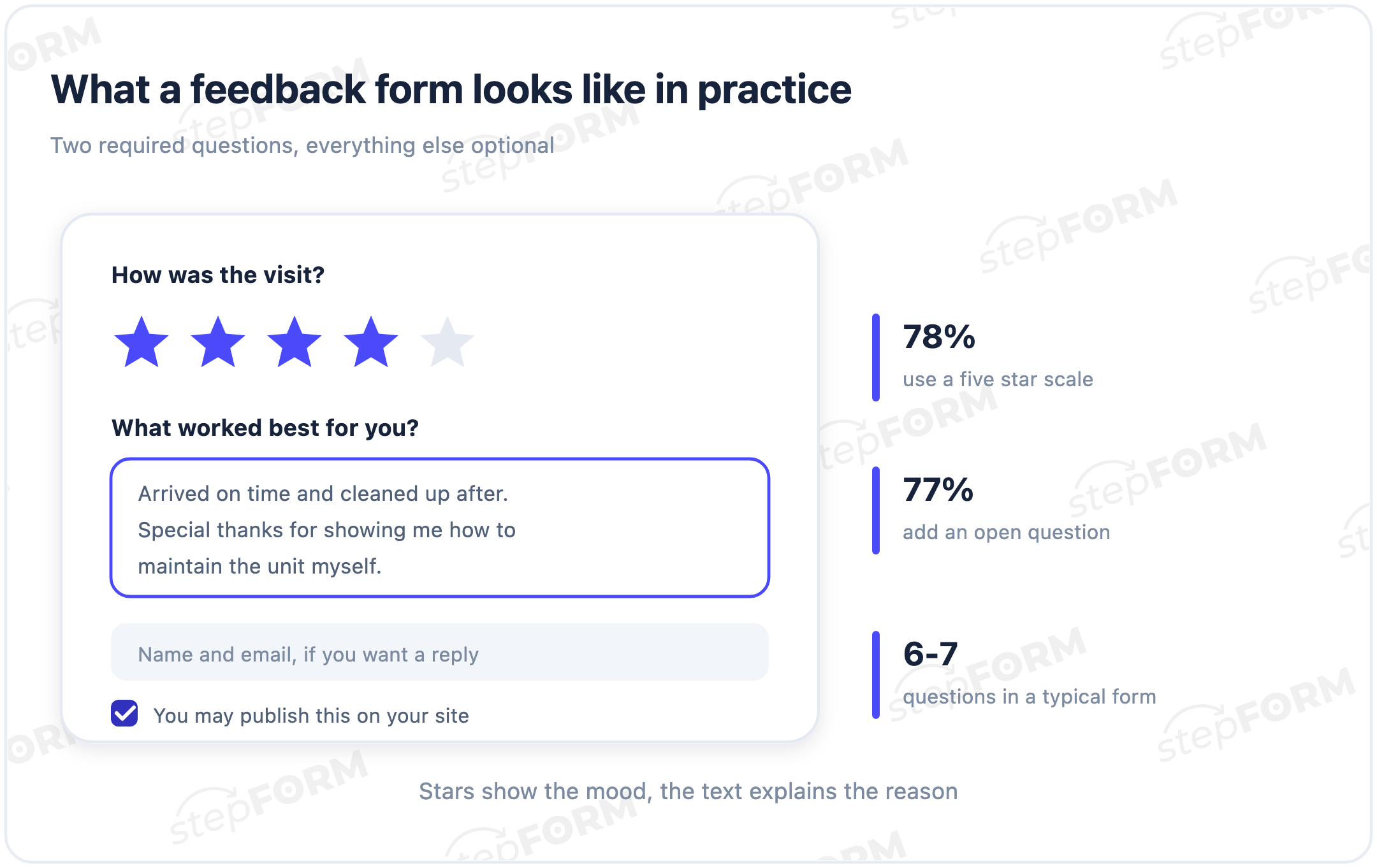
77% of them include an open text field, which is 3,105 forms. The remaining quarter collect a number and nothing else, and those are the forms that produce nothing usable. A single star tells you neither what to fix nor what to quote.
Scale choice splits 78% for five stars and 22% for a ten point scale. Five stars matches what people already see on Google and on maps, so they do not have to translate their opinion into your units.
Why the average score misleads you
Before you pick a scale, look at what people do with it. We took a year of ratings on the five star scale, 65,863 of them.
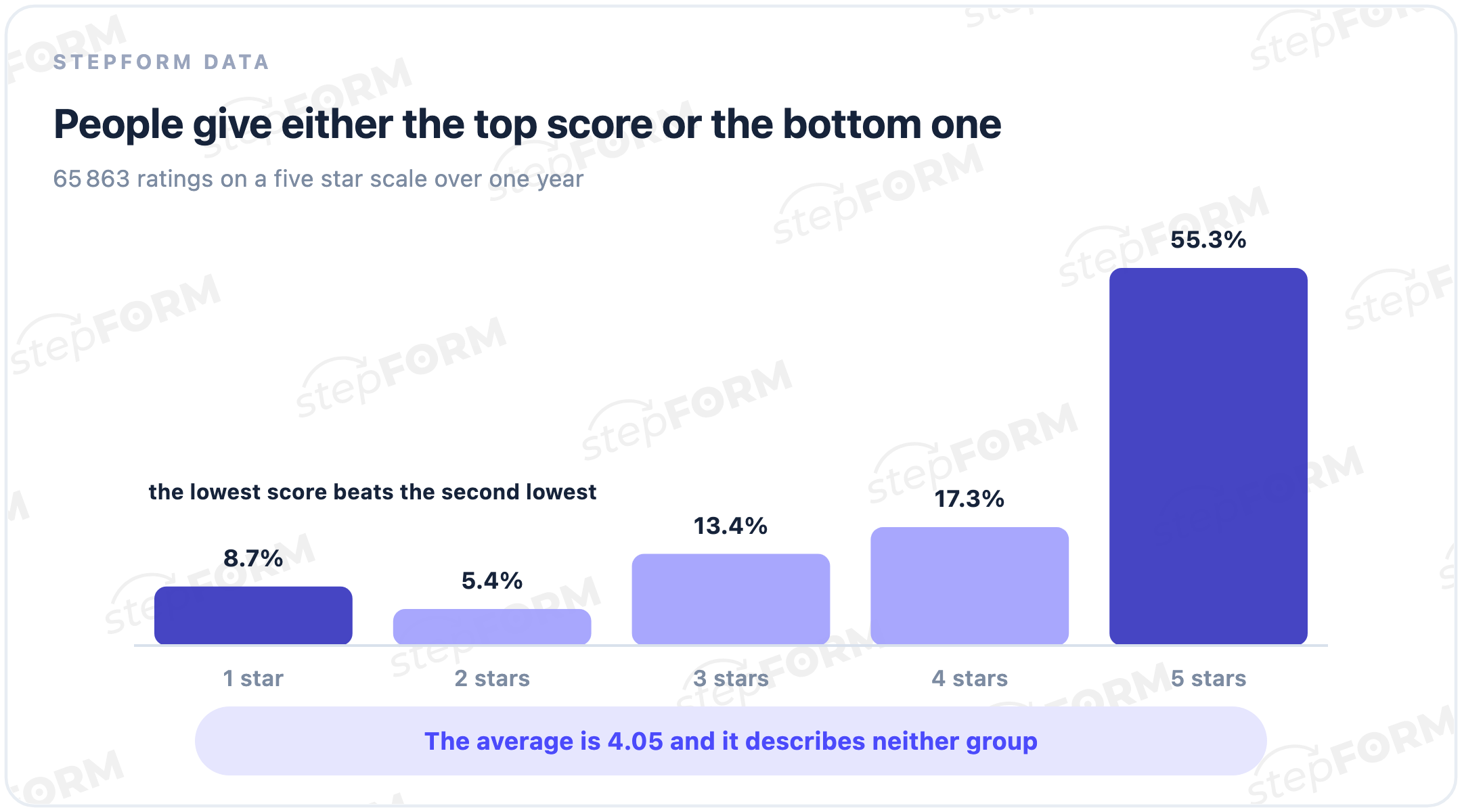
The average works out to 4.05, and it describes almost nobody. More than half of all people pick the maximum. The second most common answer is not four stars.
We checked this against an independent sample: 14,329 ratings on the ten point scale. The same shape appears. The maximum is picked by 60.4%, the average lands at 8.61, and a score of 1 is again more common than 2 or 3. Two different scales produce the same shape, so this is behaviour, not question design.
| Rating | Share, five star scale |
|---|---|
| 5 stars | 55.3% |
| 4 stars | 17.3% |
| 3 stars | 13.4% |
| 1 star | 8.7% |
| 2 stars | 5.4% |
Practical consequence: stop tracking the average. Track two shares separately, the percentage giving the maximum and the percentage giving the minimum. An average can climb from 4.05 to 4.2 while the number of angry customers grows, and you will not see it.
Building the form step by step
The mechanics are the easy part. Here is the order that works.
- Start with the rating. Put it first and make it the only required question. One click is a low barrier, and once someone has started answering they tend to continue.
- Add one open question. Not a generic invitation, a specific question. The next section covers wording.
- Leave contact details optional. Ask for a name or an email only if you genuinely intend to reply. Every required field here costs you responses.
- Add a consent checkbox if you will publish. A name and a photo are personal data. Collect explicit permission in the same form and store it with the answer.
- Branch the thank you screen. A low score gets a follow up question and a promise to respond. A high score gets a thank you. Both screens carry the same link to your public profile.
- Route the answers somewhere visible. Email, a chat channel or your CRM. Feedback that lands only in a dashboard nobody opens is feedback you did not collect.
What to actually ask
A generic invitation hands the work back to the customer: they have to decide what to write about. A specific question removes that and gives you text you can use.
| Situation | Weak question | Question that works |
|---|---|---|
| Service | Please leave feedback | What part of the visit went better than you expected? |
| Physical product | Rate your purchase | Did the item match what the description promised? |
| Course or training | Did you enjoy it? | What have you already used since finishing? |
| B2B software | Are you happy with us? | Which task does this handle better than your old tool? |
| After a low score | What went wrong? | At which step did it start going wrong? |
The last row matters most. "What went wrong" invites a general complaint and you get an emotion back. Asking about a specific step returns the person to facts, and you get a description of something you can fix.
Why your form is not convertingHow many responses to expect
This is where most guides go quiet, so here are our numbers. Of those 4,007 forms with a rating field, only 2,145 ever received a single answer.
In other words, nearly half of all feedback forms collect nothing at all. They were built, published and left to wait. Waiting does not work.
| Responses collected | Number of forms | Share of working forms |
|---|---|---|
| Exactly one | 541 | 25% |
| Between 2 and 10 | 836 | 39% |
| Between 11 and 50 | 461 | 21% |
| Between 51 and 200 | 204 | 10% |
| More than 200 | 103 | 5% |
Almost two thirds of the forms that worked at all collected ten responses or fewer. The average across forms is 62, because a handful of large forms collected thousands. That average describes the skew, not a typical form.
What platform rules forbid
There is a popular scheme that goes like this: ask for a score privately, send the happy customers to Google and keep the unhappy ones to yourself. It is called review gating, and it is against the rules.
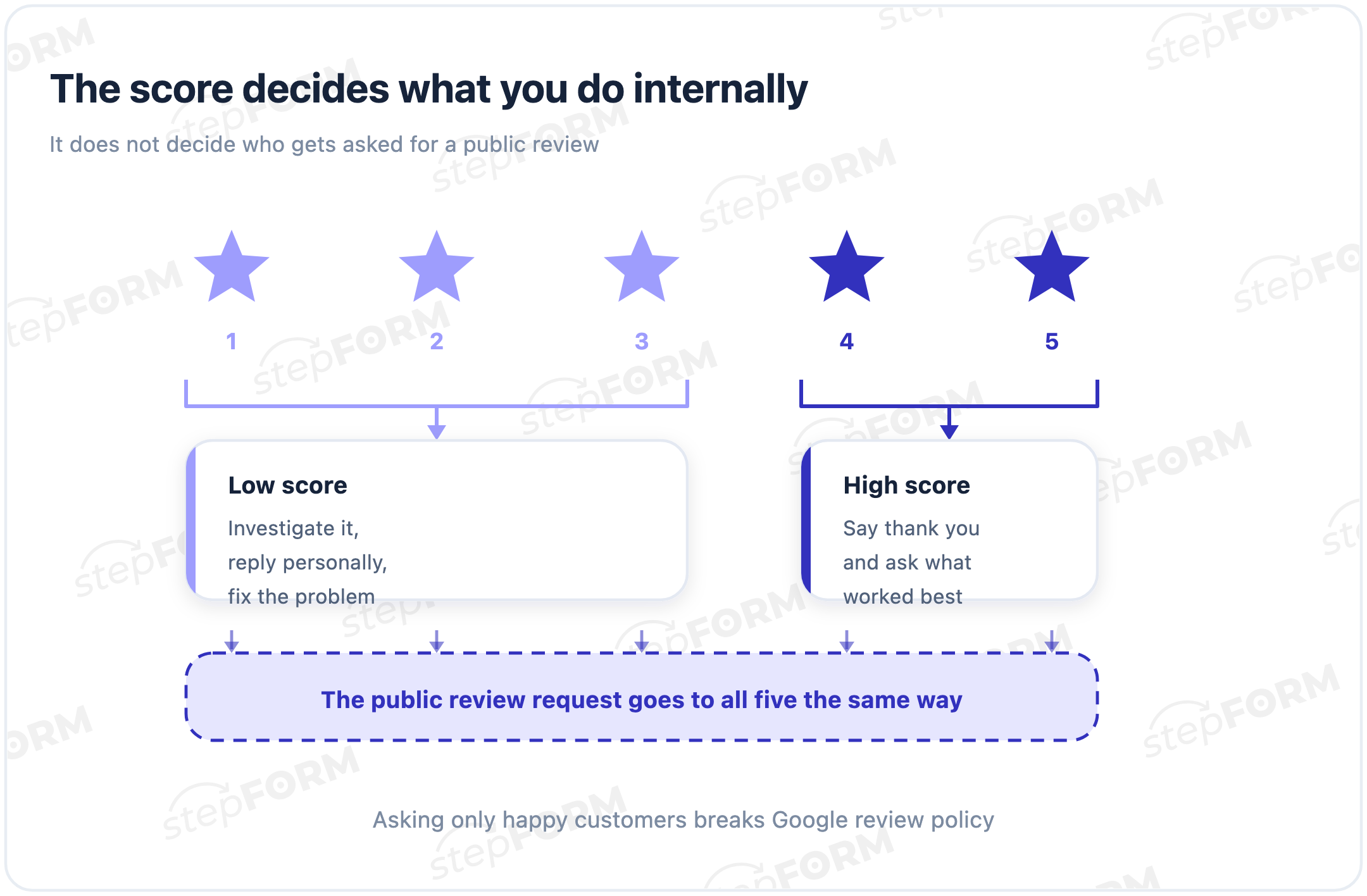
Google's contribution policy states that a business must not discourage or prohibit negative reviews, or selectively solicit positive reviews from customers. The same policy forbids offering incentives such as payment, discounts or free goods in exchange for a review. Asking for reviews is allowed, as long as you do not influence the rating or the content.
Yandex, which matters if you operate in Russian speaking markets, treats a review as fake when the author did not interact with the company or was paid for the comment. Some of its services do allow a discount for leaving a review, with the caveat that the review must not be positive purely to earn the bonus.
Common mistakes
- Reply to every low score within a day, even when the reply is simply acknowledging the problem
- Track the share of maximum and minimum scores monthly instead of the average
- Publish names and photos only with explicit consent collected in the form
- Deleting negative feedback from your own page: a wall of five star reviews reads as fake
- Rewriting feedback in your own words: that is marketing copy, not a review
- Asking a month later, when the impression has faded and the response rate collapses
Building it in stepFORM
The scenario uses three questions. Add a Rating field first and set it to five stars if you plan to ask for public reviews later, so the scale matches what people already know. Add a text field with a specific question second. Add an optional name and contact third, with a consent checkbox beside them.
Then set up the logic. A low score opens a screen with a follow up question, a high score opens a thank you screen, and both carry the same link to your public profile. Send answers to email, a messenger or your CRM so somebody sees them the same day.
If the form is live but empty, the problem is usually the path to it rather than the form itself. The full chain from impression to delivery is covered in a separate guide on why a website form stops producing leads.
Frequently asked questions
How many questions should a feedback form have?
Two is enough: a rating and one specific open question. In our data the typical rating form carries six or seven questions, but that usually means a lead form was merged into it. If you need both an order and an opinion, use two forms at two different moments.
Five stars or a ten point scale?
Five stars if you plan to ask for public reviews, because it matches the scale people already see on Google and on maps. Ten points make sense when you compare periods internally. The choice does not change behaviour: on both scales people pick the ends.
Can I offer a discount in exchange for a review?
Google's policy forbids it outright, listing payment, discounts and free goods or services as prohibited incentives. Yandex is softer and some of its services permit a discount, provided the review is not positive merely to earn it. The safe approach is to ask without any reward.
What should I do with a negative review?
Reply publicly and factually, without arguing, then fix the issue privately. Do not delete it from your own page. One star appears more often than two in our data, so unhappy customers arrive regularly and a page without any of them looks manufactured.
My form is live but nobody fills it in. Why?
Because a published form does not create a reason to write. Nearly half the rating forms in our data never received a single response, and two thirds of the working ones collected ten or fewer. What produces feedback is a routine request sent shortly after the customer got their result.
Should I show feedback on my own website?
Yes, with the score and the date, and not only the maximum ones. A page of nothing but five star reviews reads as paid. Publishing a name or a photo requires consent, so collect that checkbox in the same form as the feedback itself.
How do I know whether things are improving?
Count the number of responses per period, then track the share of maximum and minimum scores separately. The average is unsuitable: because the distribution has two peaks, it can rise at the same time as the number of unhappy customers.
Is a feedback form the same as a survey?
No. A feedback form captures one reaction to one completed experience and is usually two questions long. A survey studies a question across a population and needs sampling, question order and analysis. If you need the second one, use a survey tool rather than stretching a feedback form to fit.

 Dmitry Molchanov